
Shocking Shakahola Cult Case: Pastor Mackenzie Found Guilty Of 191 Murders
 Follow us on Google News
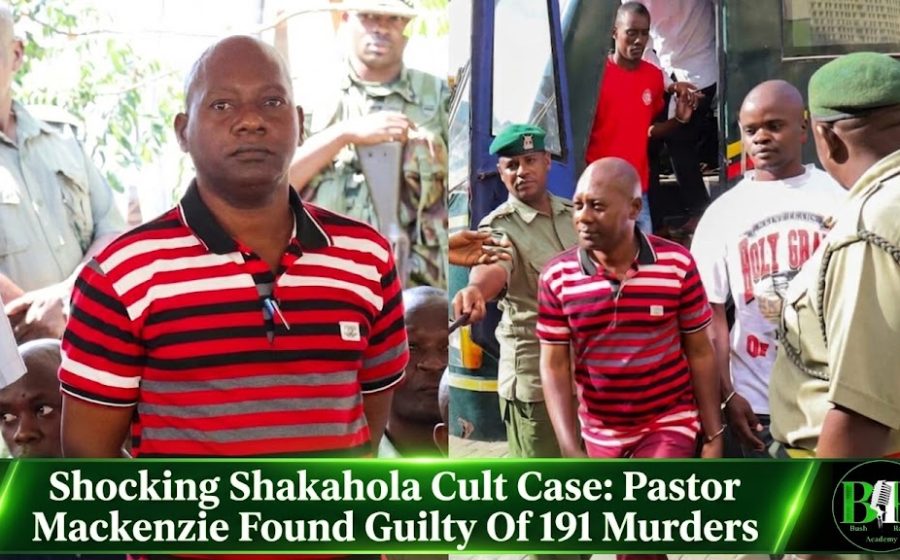
A Kenyan court has convicted pastor Paul Mackenzie of murdering 191 followers of his religious group, including 190 children, in a case that has drawn international attention to one of the country’s most disturbing religious-related mass death incidents.
According to Bush Radio Academy, Justice Diana Mochache delivered the ruling in Mombasa after an eight-hour court session, finding Mackenzie guilty of the murders. Twenty-eight other leaders associated with the group were also convicted. The defendants had denied the charges, arguing that followers had not been forced to die.
During the proceedings, the court heard that Mackenzie instructed his followers to undertake prolonged fasting as part of their preparation to “meet Jesus”. A co-defendant reportedly told the court that members who resisted the instructions could be forced to continue fasting through violence.
Those who refused to comply were allegedly subjected to physical assault, including kicks and blows, until they followed the instructions.
Justice Mochache also heard accounts of how burials in Shakahola forest were described within the group as “weddings”, with deceased followers said to have “wedded with Jesus”. The scale of the deaths became apparent after authorities discovered numerous bodies buried in shallow graves across the forest.
Seventeen men from a nearby town were reportedly recruited to exhume the graves, with some receiving as little as $8 per day for the work. One of the workers, identified as James, told the BBC that several graves contained multiple bodies, including babies only weeks old and 12 children buried together in one grave.
Other victims were reportedly found with their hands and legs tied, while some bodies had been wrapped in bedsheets.
Another gravedigger, Salim Karisa, said some of the victims were familiar to residents in communities surrounding Shakahola because members of the group occasionally visited nearby areas to purchase food and collect water. He noted that the group’s secretive activities made it difficult for outsiders to understand what was happening inside the forest.
Mackenzie established Good News International Ministries in 2003 and gradually attracted thousands of followers through church branches across Kenya. The organisation also operated Times TV, which broadcast his sermons from Malindi.
His teachings reportedly included claims that formal education was evil, medical treatment conflicted with religious doctrine and digital identity cards represented “the mark of the devil”.
Mackenzie’s son, Dan Paul Mackenzie, said he worked as a cameraman for the church. He recalled services during which children sat behind adults while worship continued for extended periods.
The church’s main branch closed in 2019. Mackenzie subsequently relocated to Shakahola forest and encouraged followers to join him there.
Among those who moved to the forest was Peter Shukrani, who went with his mother. He had attended Mackenzie’s church from the age of eight and regarded the pastor as his spiritual father.
However, Shukrani’s experience changed after he became seriously ill in the forest. He said his mother, influenced by the pastor’s teachings that medicine was evil and only God could heal him, discarded the medication he needed.
According to Shukrani, members lived in mud houses scattered across the forest and endured periods of fasting followed by small meals. He was eventually rescued after becoming bedridden for several weeks.
“My mother believed Pastor Mackenzie’s doctrine that medicine was evil. I would have died if I wasn’t rescued from Shakahola forest,” he said.
The first remains were discovered by local herders in March 2023, by which time hundreds of people were believed to have died. Karisa said some followers were so weak that they died while being carried out of the forest.
Many of the recovered bodies have remained unidentified because of decomposition. Court records have consequently referred to some victims as “unknown male child”, alongside details about the locations and dates on which their remains were found.
Despite the evidence presented during the proceedings, Shukrani had continued to defend Mackenzie before the verdict, maintaining that followers had voluntarily chosen to fast because of their religious beliefs and describing the pastor as someone who cared for him.
Dan Paul Mackenzie, however, argued before the ruling that his father should be held responsible because followers looked to him for leadership.
“He was the leader, he was someone who they were looking [up to]. So he is a murderer of mass killing,” he said.
The convictions mark a significant development in the Shakahola case, which exposed the deadly consequences alleged to have followed the group’s practices and raised serious questions about the protection of vulnerable followers from religious exploitation.




Comments
0 comments