
Abuja School Crisis: Lady Exposes Shocking Conditions Children Are Forced To Learn In
 Follow on Google News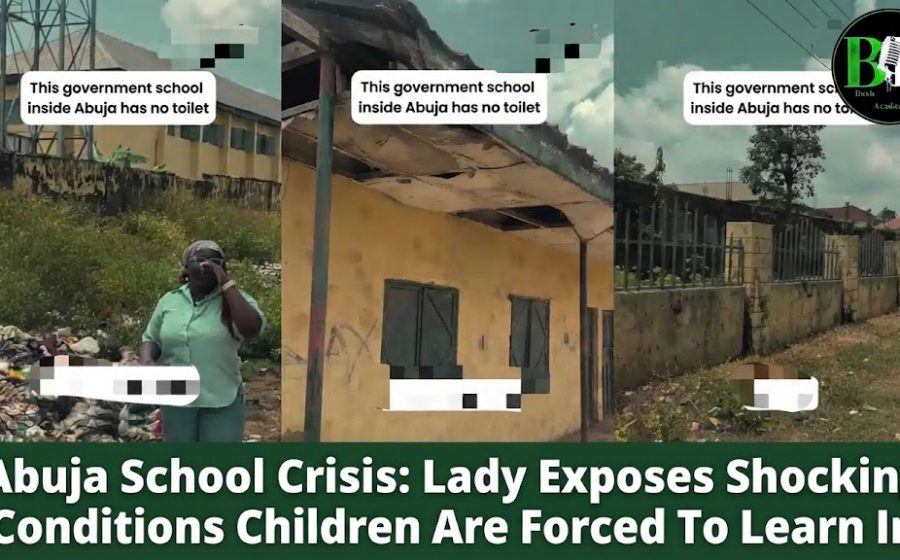
A woman has raised concerns over the reported condition of a government-owned primary school in Abuja, drawing attention to the state of basic education infrastructure and the learning environment available to some pupils.
In a video shared on social media, the woman showed what she described as an uncompleted school building, overgrown areas and inadequate facilities within the school premises.
“This is what a government primary school in the heart of Abuja looks like,” she said while displaying parts of the school environment.
The woman further alleged that the pupils had limited access to toilet facilities, claiming that some children were forced to urinate outside because of the situation.
“This is where children pass daily and this is where they learn,” she said, expressing concern over the environment in which the pupils receive their education.
According to Bush Radio Academy, the woman also questioned the level of government investment in basic education and expressed concern that funding challenges could affect the quality of facilities available in public schools.
She referenced the Universal Basic Education Commission (UBEC), noting that basic education funding involves contributions from different levels of government as well as federal intervention. UBEC states that the Universal Basic Education programme is funded by states and local governments with support from the Federal Government through intervention funds.
UBEC also states that its responsibilities include disbursing federal UBE intervention funds to states and other providers of basic education, as well as monitoring the use of those funds.
The woman alleged that an unnamed source within the school told her that government funding was not adequately reaching the institution and that the school relied heavily on contributions from the Parent-Teacher Association and members of the community. The claim could not be independently verified from the information provided.
She argued that inadequate investment in foundational education could have long-term consequences for children, stressing that pupils require suitable learning environments to develop the skills needed for their future.
Her concerns come amid wider efforts to improve basic education and foundational learning in Nigeria. In 2025, the World Bank approved $500 million in additional financing for the HOPE-EDU programme, which is designed to improve foundational learning, expand access to basic education and strengthen education systems across participating Nigerian states. The programme is expected to benefit public primary schools, teachers and millions of pupils.
The World Bank also reported in February 2026 that deficits in learning, health and workplace skills were imposing significant long-term economic costs on Nigeria, highlighting the importance of stronger investment in human capital.
The woman concluded by calling for greater attention to the condition of public schools and the quality of foundational education, arguing that children need safe and adequate learning environments to have a stronger chance of succeeding in the future.







Comments
0 comments