
After Government House: What Political Future Awaits Zulum?
 Follow us on Google News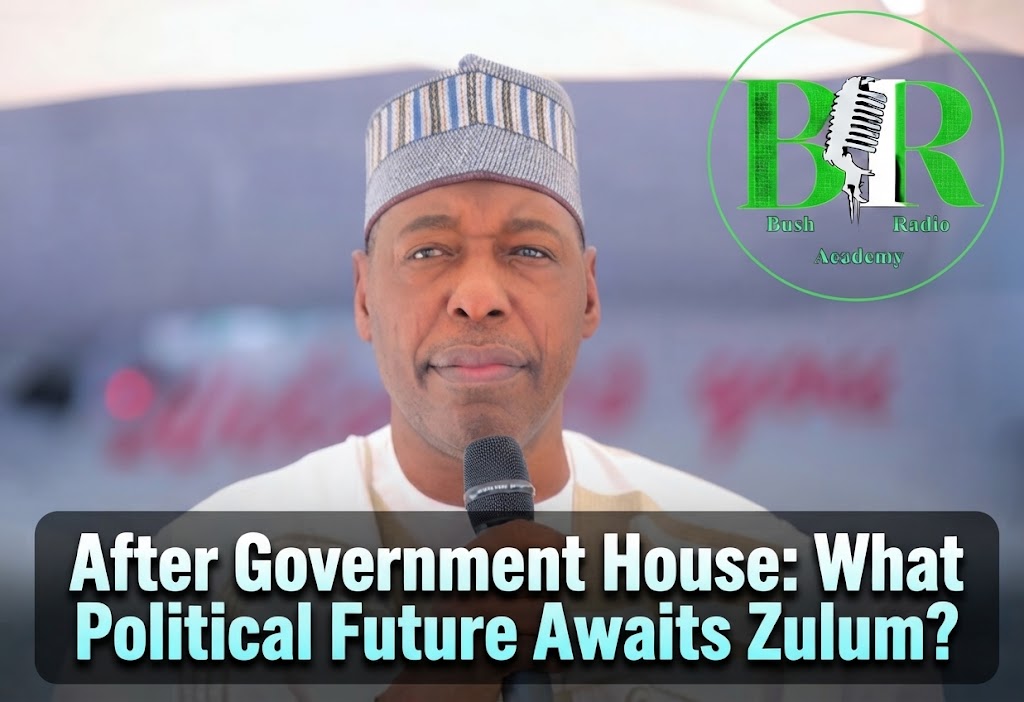
Governor Babagana Umara Zulum is approaching the end of his second and final term in office, but unlike many outgoing governors who secure Senate seats before leaving Government House, his political future after 2027 remains uncertain.
According to Bush Radio Academy, Zulum’s decision not to contest the Borno Central Senatorial seat has intensified speculation over what lies ahead for the Borno State governor. Rather than pursue a familiar transition into the National Assembly, he appears to have focused more attention on the process of choosing his successor within the All Progressives Congress (APC).
The development has sparked widespread debate over whether Zulum’s next destination will be Abuja, academia, international development or a broader national political role.
For many outgoing governors, the Senate provides an easy route to remain politically active after completing their constitutionally permitted eight years in office. Zulum, however, has chosen a different path despite reported pressure from supporters to seek the Borno Central seat currently occupied by Senator Kaka Shehu Lawan.
His decision has attracted attention because a Senate position would have offered him a direct platform to maintain influence in national politics. Instead, the succession battle in Borno appears to have taken centre stage.
Political calculations surrounding the governorship race reportedly changed after Engineer Mustapha Gubio emerged as a preferred aspirant linked to Zulum, while Senator Lawan remained in contention for his Senate seat. The changing dynamics eventually complicated earlier expectations about the governor’s preferred political succession plan.
Zulum’s dissolution of the State Executive Council also fuelled speculation about his intentions, with observers closely watching the governor’s moves as the APC succession contest intensified.
With the political landscape evolving, analysts believe Zulum may now have to consider options beyond the conventional path followed by former governors.
One possibility is a federal appointment if President Bola Ahmed Tinubu secures another term in 2027. Supporters have at various times projected Zulum for a ministerial position, including the Ministry of Works, although such expectations remain speculative.
His background and experience could, however, strengthen his prospects for a national assignment. Before becoming governor in 2019, Zulum served as Borno’s Commissioner for Reconstruction, Rehabilitation and Resettlement, where he was deeply involved in rebuilding communities affected by insurgency, supporting displaced persons and coordinating with development partners.
As governor, he continued those efforts through investments in education, healthcare, agriculture, housing, roads and support for security agencies. His administration also worked with international organisations on humanitarian assistance, reconstruction, food security and community resilience.
These experiences could potentially position Zulum for a role in international development institutions, humanitarian organisations or global policy bodies dealing with conflict recovery and fragile communities.
Another possible destination is academia. Before entering politics, Zulum established himself as an academic at the University of Maiduguri, where he rose to the rank of professor of Engineering. He also served as Rector of Ramat Polytechnic, Maiduguri, where he implemented several reforms.
A return to teaching, research, public policy or university administration could therefore offer the governor a natural avenue to continue his professional career. He could also combine academic work with advisory responsibilities involving governments, development agencies and international organisations.
Beyond formal political appointments, Zulum could emerge as an influential national voice on issues including insecurity, education, humanitarian affairs and poverty reduction. His experience governing Borno during years of insurgency could provide him with a platform to contribute to national policy discussions even without holding elective office.
Ultimately, the significance of Zulum’s post-2027 career may depend less on the title he assumes and more on the extent to which the policies and institutions established under his administration endure.
His administration has pursued reconstruction, educational expansion, resettlement programmes, healthcare investment and cooperation with security agencies. It has also introduced policy frameworks including the Borno State 25-Year Development Plan and 10-Year Strategic Plan, the Borno Model for Peace, Reconciliation and Development, the strategy for durable solutions to internal displacement and a Transitional Justice Framework.
As his tenure draws closer to its conclusion, Zulum stands at a significant political crossroads. Without a Senate seat awaiting him, his next move remains open to several possibilities.
Whether he eventually heads to Abuja, returns to academia, takes up an international development role or establishes himself as a national policy advocate, his experience in governance suggests that his public-service journey may continue beyond Borno Government House.
For now, the question remains: what exactly comes next for Babagana Zulum after Government House?







Comments
0 comments