
Don’t Poison Me!’ — Sowore Reveals Fear After Heated Amaechi Encounter
 Follow us on Google News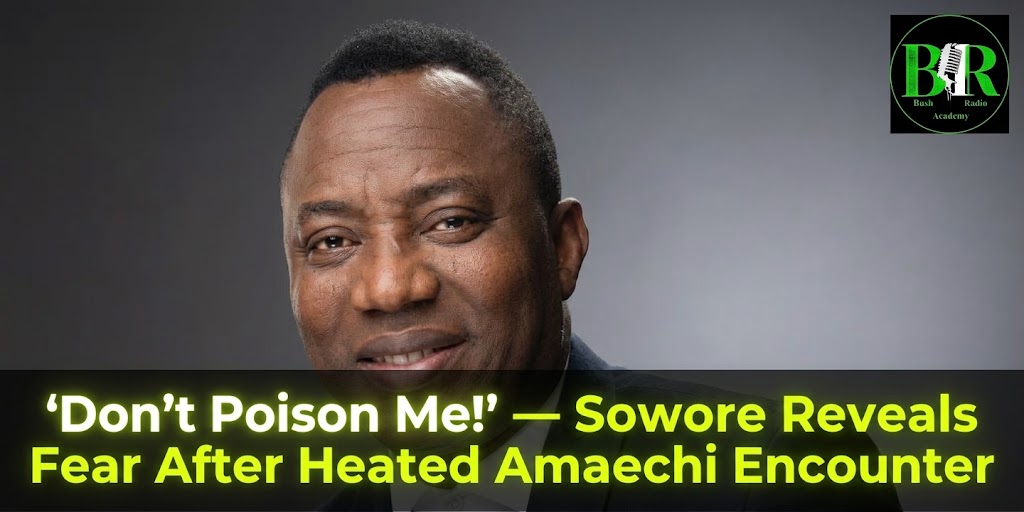
The presidential candidate of the African Action Congress (AAC), Omoyele Sowore, has disclosed that he demanded an apology from former Rivers State Governor, Rotimi Amaechi, following their heated exchange at the Nigerian Bar Association (NBA) Annual General Conference in Port Harcourt.
Sowore said the disagreement, which occurred during the conference’s political session on Monday, was rooted in differences over their respective roles and contributions to Nigeria’s political development and governance.
The AAC candidate made the disclosure on Tuesday while speaking on Arise News, where he also defended his political credentials despite never having occupied an elective public office.
Sowore said he contacted Amaechi after the event and told him that the former governor owed him an apology.
According to him, Amaechi responded by inviting him to his residence for food and drinks. Sowore said he jokingly declined the invitation, saying he did not want to be poisoned because Amaechi was unhappy with him.
He, however, clarified that the comment was made in jest and that he did not genuinely believe Amaechi would harm him.
Sowore also argued that his activism during Nigeria’s pro-democracy struggle helped create the political environment that enabled politicians such as Amaechi to rise to positions of political leadership.
He maintained that if the country had remained under military rule, Amaechi would not have become Speaker of the Rivers State House of Assembly, governor or Minister of Transportation.
The AAC candidate said many politicians who currently occupy leadership positions benefited from the democratic system that activists fought to establish.
Sowore further insisted that his lack of experience in elective or ministerial office should not be used to discount his understanding of leadership and governance.
He said his years of activism had exposed him to issues surrounding democratic accountability, good governance and national development, giving him a perspective different from that of career politicians.
According to him, effective leadership goes beyond professional expertise, requiring an individual who understands different sectors and can bring together competent people to achieve results.
Sowore maintained that politicians who benefited from Nigeria’s democratic system should recognise the contributions of those who fought for its restoration.
The dispute between Sowore and Amaechi began during the NBA conference after the AAC candidate criticised the records of former public officials, including the former Rivers governor.
Sowore questioned Amaechi’s achievements as governor and his tenure as Minister of Transportation, particularly his handling of railway projects and the petrol subsidy issue.
He had told the gathering that Amaechi built a railway project that, in his view, failed to deliver the expected benefits to Rivers residents.
Amaechi rejected the criticism and defended his record in office, citing roads and primary schools constructed during his tenure as governor, as well as the Lagos-Ibadan and Abuja-Kaduna railway projects completed while he was Transportation Minister.
The former governor also challenged lawyers from Rivers State to take Sowore around the state to inspect projects executed under his administration.
The exchange became heated when Amaechi told Sowore, “When politicians are talking, close your mouth.”
Speaking about the incident afterwards, Sowore said the confrontation had not changed his position on Nigeria’s economic policies.
He reiterated his opposition to the removal of the petrol subsidy, saying he had warned that the policy would have negative consequences for the economy.
Sowore argued that the economic difficulties experienced following the subsidy removal had vindicated some of his earlier warnings.
He maintained that leadership should ultimately be judged by a person’s vision, convictions, ability to mobilise people and commitment to addressing the country’s challenges, rather than solely by whether the individual has previously occupied a government position.






Comments
0 comments