
Latest
Falana Urges FG To Take South Africa To Court Over Killings Of Nigerians

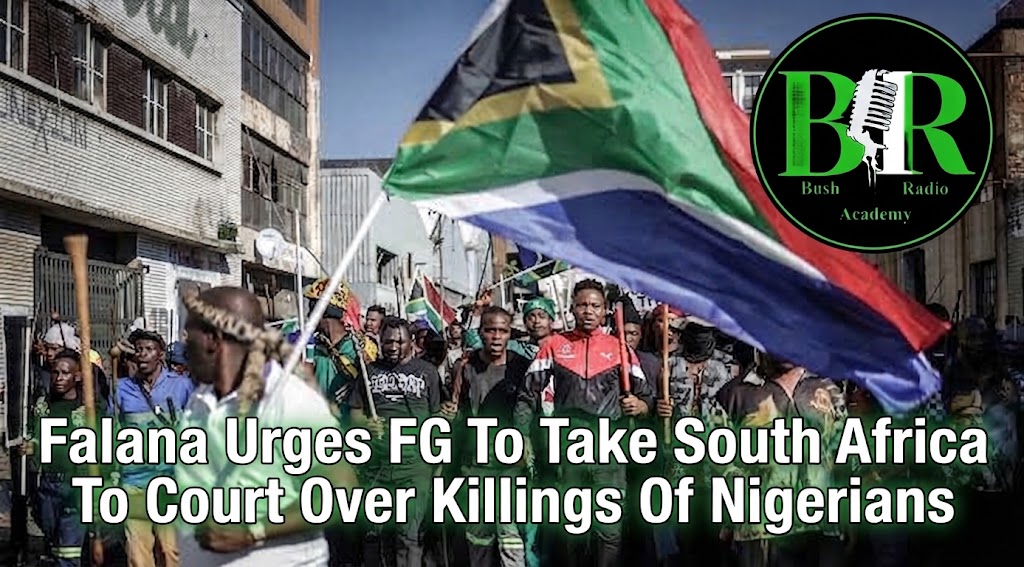
A Senior Advocate of Nigeria, Femi Falana, has urged the Federal Government to go beyond diplomatic condemnations and commence legal proceedings against South Africa over the alleged killings and mistreatment of Nigerians in the country.
According to Bush Radio Academy, Falana made the call following the reported killing of Nigerian cleric Bishop Michael Taiwo Fakunle in Johannesburg on September 4, 2026.
Falana said Fakunle was allegedly shot dead by unknown gunmen at his residence after reportedly receiving threats. He added that barely 24 hours later, another Nigerian, James Uchechukwu Nwankwo, reportedly died following an alleged interrogation by officers of the South African Police Service.
Citing comments attributed to Nigeria’s High Commissioner to South Africa, Femi Fani-Kayode, Falana claimed that the two deaths brought the number of Nigerians allegedly killed in South Africa in 2026 to eight, with four reportedly linked to South African security personnel.
The human rights lawyer further alleged that more than 100 Nigerians had been killed in South Africa between 2022 and 2026, including over 30 who were reportedly killed by personnel of the South African Police Service and South African Defence Force.
Falana expressed concern that despite repeated complaints and concerns raised by the Nigerian government, those allegedly responsible for the killings had not been arrested, prosecuted or brought to justice.
He argued that Nigeria has both constitutional and international human rights obligations to protect its citizens and seek justice when their fundamental rights are violated abroad.
The Senior Advocate therefore called on the Federal Government to institute an interstate case against South Africa before the African Court on Human and Peoples’ Rights.
To support his argument, Falana cited the African Court’s ruling in the case involving the family of slain Burkinabe investigative journalist Norbert Zongo. He noted that Burkina Faso was held responsible for failing to properly investigate Zongo’s assassination and was ordered to pay reparations.
Falana also referenced the ECOWAS Court’s decision in the Apo Six case, in which Nigeria was held responsible for human rights violations connected to the killing and ill-treatment of citizens during a security operation in Abuja.
According to him, the cases demonstrate that a failure by a state to properly investigate serious violations of the right to life can result in state responsibility.
Falana noted that Nigeria and South Africa are both parties to the African Charter on Human and Peoples’ Rights and have ratified the protocol establishing the African Court.
He recalled that in July 2026, he had urged Nigeria, Ghana and other African countries affected by xenophobic attacks to take South Africa before the African Court. He also disclosed that he petitioned the African Commission on Human and Peoples’ Rights in May over alleged xenophobic attacks and other violations against Nigerians and other African nationals in South Africa.
The lawyer further urged the Federal Government to make the declaration required under Article 34(6) of the African Court Protocol, which would allow individuals and eligible non-governmental organisations to bring cases directly before the Court.
Falana also called for the establishment of a coordinated mechanism involving the Ministry of Foreign Affairs, Nigeria’s diplomatic mission in South Africa and the Federal Ministry of Justice to document reported cases of killings, torture and other serious abuses against Nigerians.
He said such a mechanism should also monitor investigations and prosecutions to ensure that victims and their families are not denied justice.
Falana maintained that South Africa has a responsibility to protect Nigerians and other African nationals living within its territory, insisting that the Federal Government must take stronger steps to protect its citizens, demand accountability and use available regional legal mechanisms to pursue justice and compensation for victims and their families.


MOMOH REPRESENTS PRESIDENT TINUBU AT ESAMA’S 92ND BIRTHDAY—DELIVERS TRIBUTE CELEBRATING HIS UNCOMMON ENTERPRISE AND NATIONAL IMPACT

Obasanjo Reminds South Africa Of Nigeria’s Crucial Role In Ending Apartheid

Drama As Warri Pikin Breaks Silence After Viral Moment With Timaya On Stage

Dangote Makes Stunning Revelation: I Bought My First Private Jet At 22-And-A-Half

Study In UK For Free FG Announces 2027 Commonwealth Master’s, PhD Scholarship Application

THE 18,439-VOTE MISSION WHY WADADA COULD BE TINUBU’S NASARAWA GAME CHANGER

Fake Miracle Exposed! Nollywood Actor Reveals How He Was Paid To Stage One

KWARA IS NOT RIVERS—BUT INJUSTICE HAS NO STATE OF ORIGIN

Marriage Advice Sparks Debate As Lady Reveals Lie Women Should Tell Men
