
Fresh Fuel Hike Hits Nigerians As Dangote Switches To US Dollar Payments
 Follow us on Google News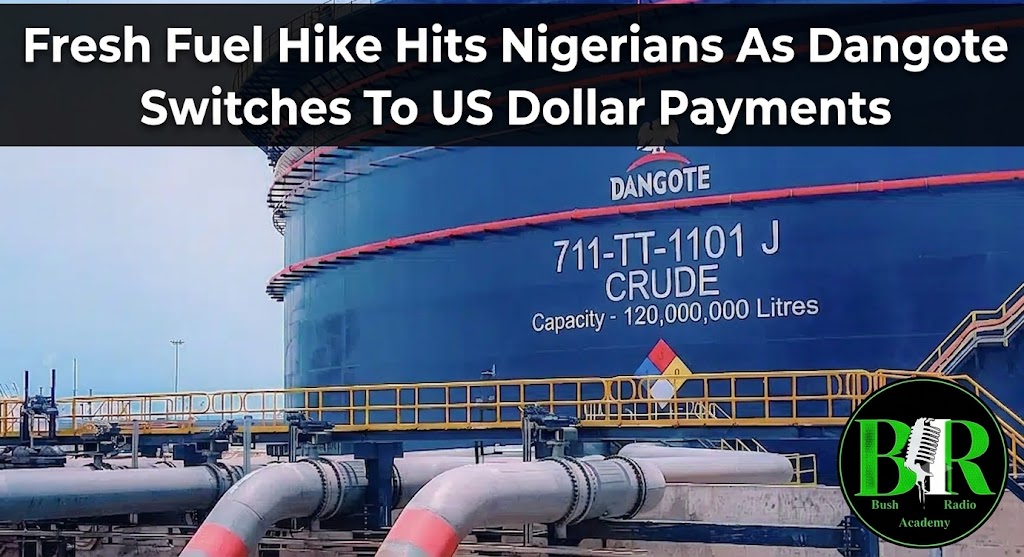
The price of Premium Motor Spirit (PMS), popularly known as petrol, has risen by more than ₦100 per litre at some depots following Dangote Petroleum Refinery’s decision to begin selling its refined petroleum products in United States dollars.
The new pricing policy is expected to significantly increase the demand for foreign exchange, with petroleum marketers projected to require about $1.84 billion monthly to purchase petrol, diesel and aviation fuel from the refinery.
Energy experts and downstream operators have warned that the move could put additional pressure on Nigeria’s foreign exchange market, reduce liquidity and expose consumers to more frequent fuel price increases.
The policy has already triggered upward adjustments in depot prices, with petrol rising by more than ₦100 per litre at several loading facilities.
Industry stakeholders noted that marketers, who earn revenue in naira, will now be compelled to source dollars to purchase products from the country’s largest refinery, increasing their operating costs.
Although the dollars paid to Dangote Refinery remain within the domestic economy rather than being remitted to foreign suppliers, analysts warned that the high demand for foreign currency could still strain available FX liquidity.
Marketers May Need Over $60 Million Daily
Based on current consumption estimates, petroleum marketers are expected to require about $60.7 million daily to purchase petrol, diesel and aviation fuel from the refinery.
Petrol accounts for the largest share of the demand.
At Dangote Refinery’s new gantry price of $0.779 per litre, marketers would require approximately $36.9 million daily, translating to about $1.1 billion every month.
Diesel, officially known as Automotive Gas Oil (AGO), is priced at $1.087 per litre, requiring an estimated $20.4 million daily, or $633.5 million monthly, based on current supply volumes.
Aviation Turbine Kerosene (ATK) has been priced at $0.942 per litre, with average daily purchases projected to require about $3.4 million, amounting to roughly $105.1 million each month.
Combined, marketers could require approximately $1.84 billion monthly to procure the three major petroleum products.
Analysts warned that the development would test the capacity of Nigeria’s banking sector and foreign exchange market to meet substantial dollar demand from downstream operators.
Petrol Depot Prices Jump
Following the refinery’s announcement, petrol depot prices reportedly increased from about ₦1,137 to as much as ₦1,250 per litre at some depots, representing an increase of ₦113.
Other major depots, including Sahara, AIPEC and African Terminal, also adjusted their loading prices from around ₦1,090 to between ₦1,120 per litre.
Diesel prices also rose sharply, with ex-depot rates climbing to as high as ₦1,650 per litre, an increase of up to ₦150.
The increases came only days after the Federal Government called for lower fuel prices and amid rising global crude oil prices, which climbed to about $85 per barrel.
Industry players warned that the additional costs would likely be transferred to motorists, transport operators, manufacturers and other end users if the trend continues.
Dangote Ends Naira Invoicing
Dangote Petroleum Refinery recently notified marketers that all products lifted from its gantry would be paid for exclusively in U.S. dollars from July 13.
As a result, previously issued invoices denominated in naira were cancelled, and outstanding payments under those invoices were discontinued.
Under the revised pricing structure, PMS is sold at $0.779 per litre, diesel at $1.087 per litre, while aviation fuel costs $0.942 per litre. Coastal petrol is priced at $1,044.62 per metric tonne.
The refinery clarified, however, that the new payment arrangement does not affect Liquefied Petroleum Gas (LPG), which will continue to be sold under the existing payment framework.
Experts Warn of FX Pressure
Analysts say the decision effectively shifts foreign exchange risks from the refinery to downstream marketers, who now have to obtain dollars before purchasing products despite earning their income in naira.
The move also represents a departure from the naira-for-crude policy introduced by the Federal Government in October 2024 to reduce pressure on the foreign exchange market, support local refining and improve energy security.
Industry sources believe the return to dollar pricing may be linked to continued challenges in sourcing sufficient crude oil locally, forcing the refinery to rely more heavily on imported crude purchased in foreign currency.
Economists warned that the development could increase pressure on the naira and make domestic fuel prices more sensitive to exchange-rate fluctuations.
They also noted that marketers may shorten inventory cycles and adjust retail prices more frequently to manage exchange-rate risks.
The Managing Director of the Centre for the Promotion of Private Enterprise (CPPE), Dr. Muda Yusuf, said the overall impact on pump prices would depend largely on the stability of the naira and international crude oil prices.
Meanwhile, petroleum marketers expressed concern that the policy could gradually lead to the dollarisation of Nigeria’s downstream petroleum sector.
The National President of the Independent Petroleum Marketers Association of Nigeria (IPMAN), Shettima Maigandi, said marketers would prefer to continue purchasing products in naira since sales to consumers are conducted in the local currency.
Stakeholders warned that while the decision reflects the realities of a deregulated petroleum market, it has raised fresh questions about the future of the Federal Government’s naira-for-crude initiative and the long-term stability of Nigeria’s foreign exchange market.


Comments
0 comments