
Latest
Obasanjo Reminds South Africa Of Nigeria’s Crucial Role In Ending Apartheid

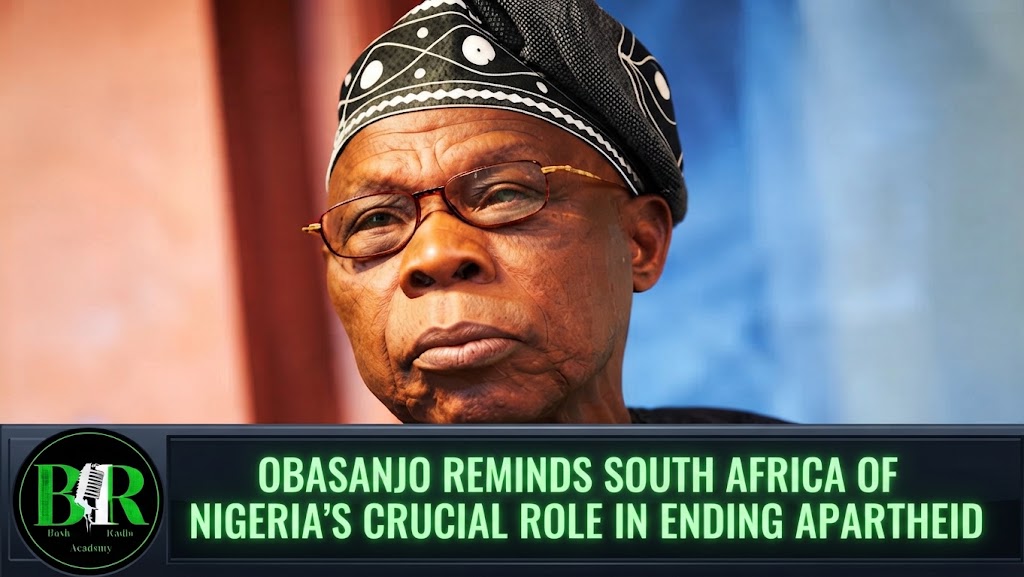
Former President Olusegun Obasanjo has said South Africa would not have achieved the historic end of apartheid in 1994 without Nigeria’s sustained support for the struggle against white minority rule.
According to Bush Radio Academy, Obasanjo made the remarks during an interview on C-Suite Cafe hosted by Ikem Okuhu, where he reflected on Nigeria’s role in supporting liberation movements across Southern Africa.
The former military Head of State explained that Nigeria’s involvement in the anti-apartheid struggle was driven by a commitment to racial equality rather than expectations of financial or political benefits.
Obasanjo said Nigeria supported the liberation struggle because of the belief that no person should be treated as inferior simply because of their skin colour.
“We were not doing what we did in South Africa or in Southern Africa or decolonisation anywhere for our personal gain or for our country. We did it for our race,” he said.
He added that Nigeria’s actions were guided by the principle that every black person deserved to be treated as an equal human being, regardless of where they lived.
According to Obasanjo, Nigeria’s contribution to the anti-apartheid struggle could be regarded as an act of enlightened self-interest, although the country did not provide the support with the expectation of receiving financial or political rewards.
The former president expressed pride in Nigeria’s historical role, insisting that the country made a significant contribution to the eventual collapse of apartheid.
“And for me, and I believe for Nigeria at that time and even now, we should be proud of what we did because without Nigeria, South Africa would not have got rid of apartheid when it got rid of it. That is true,” he said.
Obasanjo also recalled Nigeria’s collaboration with several African and international figures during the anti-apartheid and broader decolonisation struggles. Among those he mentioned were former Tanzanian President Julius Nyerere, former Zambian President Kenneth Kaunda and former Mozambican President Samora Machel.
He also cited former United States President Jimmy Carter, former British Prime Minister James Callaghan and former Swedish Prime Minister Olof Palme as some of the international figures involved in efforts connected to the wider struggle.
The former president further criticised xenophobic attacks against African migrants in South Africa, arguing that authorities should address violations through lawful means rather than allowing violence against foreigners and their businesses.
Obasanjo acknowledged that some migrants could be living in South Africa illegally or might be involved in criminal activities, but maintained that such cases should be handled through the appropriate legal channels.
“I do not believe that you use illegality to treat illegality, asking and encouraging area boys and area girls to break into their houses and break into their shops,” he said.
He also rejected the broad claim that migrants are responsible for taking jobs away from South Africans, noting that some foreigners contribute to the economy and create employment opportunities.
Obasanjo’s comments have renewed discussions about Nigeria’s historical contribution to the liberation of Southern Africa and the need for stronger African solidarity in addressing contemporary challenges.


Obasanjo Reminds South Africa Of Nigeria’s Crucial Role In Ending Apartheid

Drama As Warri Pikin Breaks Silence After Viral Moment With Timaya On Stage

Dangote Makes Stunning Revelation: I Bought My First Private Jet At 22-And-A-Half

Study In UK For Free FG Announces 2027 Commonwealth Master’s, PhD Scholarship Application

13 Years Together! Lady Makes Shocking Revelation About Husband’s Unusual Swallow-Eating Habit

THE 18,439-VOTE MISSION WHY WADADA COULD BE TINUBU’S NASARAWA GAME CHANGER

Fake Miracle Exposed! Nollywood Actor Reveals How He Was Paid To Stage One

KWARA IS NOT RIVERS—BUT INJUSTICE HAS NO STATE OF ORIGIN

Marriage Advice Sparks Debate As Lady Reveals Lie Women Should Tell Men
