
Latest
Shock Exit! Full List Of Nigerian Ministers Who Have Been Sacked Or Resigned Since 1999

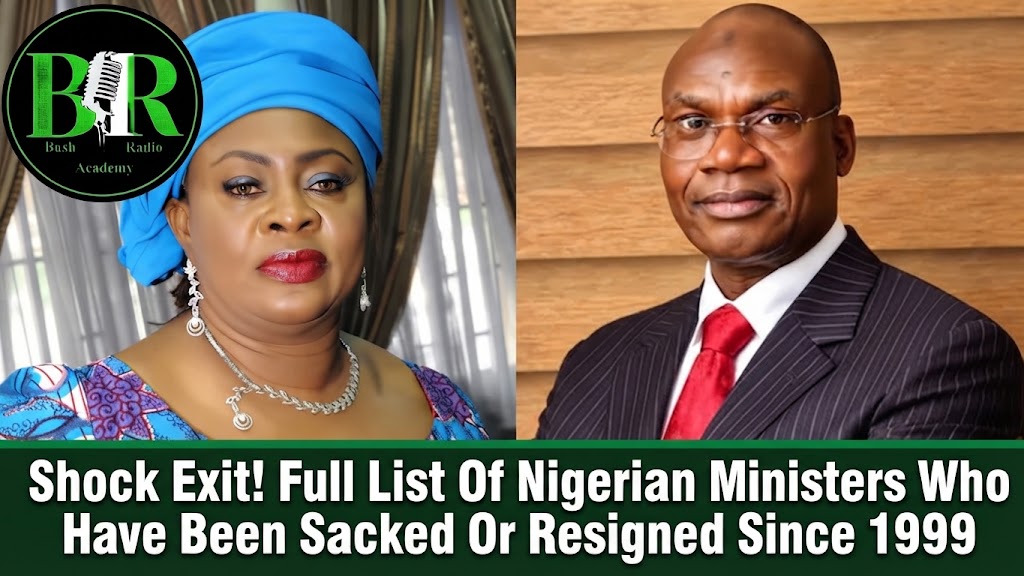
Nigeria’s Fourth Republic has recorded several cabinet shake-ups, with successive presidents dismissing, suspending, redeploying or accepting the resignations of ministers for various reasons.
Since the return to democratic rule in 1999, Presidents Olusegun Obasanjo, Umaru Musa Yar’Adua, Goodluck Jonathan, Muhammadu Buhari and Bola Ahmed Tinubu have all overseen the departure of members of the Federal Executive Council.
While some ministers were removed amid allegations of corruption, misconduct or administrative controversies, others left office during cabinet reshuffles. In some cases, ministers resigned after coming under pressure or while investigations into their ministries were ongoing.
As a result, there is no single official figure for the number of ministers who have been “sacked” since 1999, particularly because some departures were formally announced as resignations but were widely viewed as forced exits.
According to Bush Radio Academy, some of the notable cases from Nigeria’s Fourth Republic include Hussaini Akwanga, who was removed as Minister of Labour and Productivity in December 2003 during controversy surrounding the national identity card project awarded to French firm SAGEM. His exit came as the government pursued investigations and emphasised transparency in the handling of the contract.
Fabian Osuji, who served as Minister of Education, was dismissed by President Obasanjo in March 2005 following allegations that ₦55 million was offered to lawmakers in connection with the ministry’s budget. His removal was followed by an anti-corruption investigation. Osuji, who died in 2024, served as education minister from 2003 to 2005.
Another prominent case under Obasanjo was that of Alice Mobolaji Osomo, the then Minister of Housing and Urban Development. She was removed from office following controversy over the allocation and proposed sale of more than 200 Federal Government properties in Lagos’ Ikoyi area. The Presidency said the handling of the properties did not comply with decisions of the Federal Executive Council and presidential directives.
Under President Umaru Musa Yar’Adua, Health Minister Professor Adenike Grange and Minister of State for Health Gabriel Aduku resigned in March 2008 amid an investigation into approximately ₦300 million in unspent funds from the 2007 budget. Their departures were widely reported as having followed pressure to either resign or face dismissal.
Goodluck Jonathan also recorded notable ministerial exits. One of his early decisions after becoming Acting President in 2010 was to remove Michael Aondoakaa as Attorney-General of the Federation and Minister of Justice. Aondoakaa was subsequently redeployed to the Ministry of Special Duties, meaning his case was more accurately a removal from a particular cabinet portfolio rather than an immediate dismissal from government.
Professor Barth Nnaji, who served as Minister of Power, resigned in August 2012 amid concerns over a possible conflict of interest involving the privatisation of electricity assets. Companies reportedly linked to him had interests in the bidding process, prompting controversy and subsequent action by the National Council on Privatisation. Although his exit was formally recorded as a resignation, Nnaji is frequently mentioned among ministers who were forced out of office.
In August 2013, Jonathan terminated the appointment of Inuwa Abdulkadir as Minister of Youth Development. He was directed to hand over immediately to the ministry’s permanent secretary. The decision was linked to controversies surrounding the conduct of elections into the National Youth Council of Nigeria.
Jonathan later carried out one of the most significant cabinet shake-ups of the Fourth Republic on September 11, 2013, when nine ministers were relieved of their appointments. The affected ministers were Olugbenga Ashiru, Foreign Affairs; Ruqayyatu Ahmed Rufa’i, Education; Shamsudeen Usman, National Planning; Amal Pepple, Lands, Housing and Urban Development; Hadiza Mailafia, Environment; Ita Okon Bassey Ewa, Science and Technology; Olusola Obada, Minister of State for Defence; Zainab Ibrahim Kuchi, Minister of State for Power; and Bukar Tijani, Minister of State for Agriculture. Contemporary records confirm that all nine were removed from the cabinet on that date.
These cases illustrate the different circumstances surrounding ministerial exits in Nigeria since 1999. While some were clear presidential dismissals, others involved resignations, redeployments, cabinet reshuffles or departures following controversies. Therefore, any attempt to compile a definitive list of ministers “sacked” since 1999 must take those distinctions into account.


Sad Loss! Ogologomma Singer Papi Urhobo D!es After Battle With Illness

Tragic Losses: See Nigerian Governors And Leaders Who D!ed While Serving In Office

Gov. Alia Makes Fresh Allegations Against Ortom As Seized Cars Spark Controversy

Bella Shmurda Makes Shocking Confession About How He Funded His Music Career

I Was Told To Train Alone — Gabriel Jesus Reveals What Happened At Arsenal Before Barcelona Exit

THE 18,439-VOTE MISSION WHY WADADA COULD BE TINUBU’S NASARAWA GAME CHANGER

Fake Miracle Exposed! Nollywood Actor Reveals How He Was Paid To Stage One

Drama As Oluebube Reveals Why She Attended APC Campaign Event

From ₦15m To Fuel Attendant: Lady Recounts Shocking Story Of Betting Winner Who Lost His Fortune
