
Tragic Losses: See Nigerian Governors And Leaders Who D!ed While Serving In Office
 Follow us on Google News
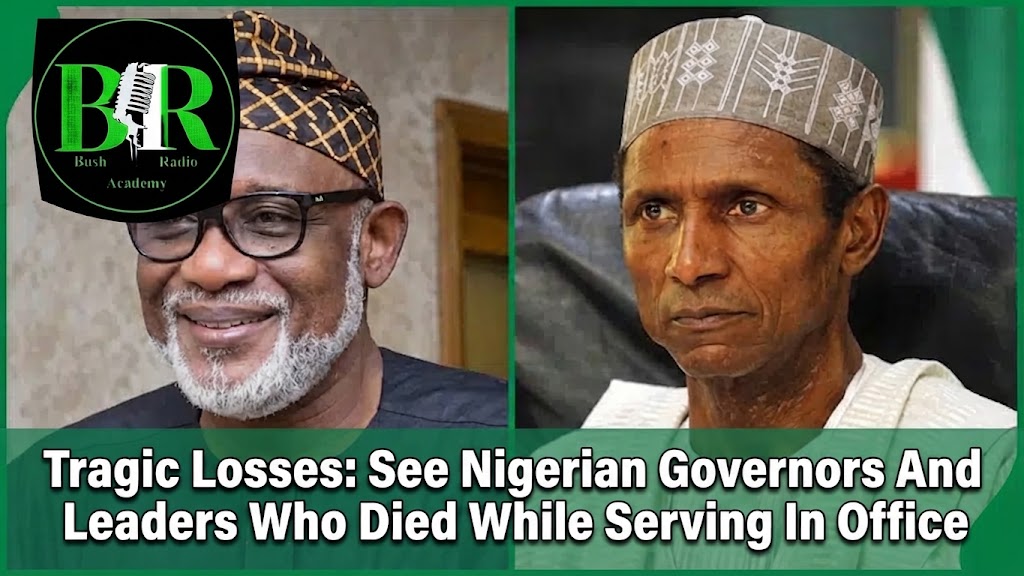
Nigeria’s political history has recorded several tragic instances in which presidents, governors, ministers and lawmakers died before completing their terms in office.
The circumstances surrounding their deaths have varied, with some losing their lives after prolonged illnesses, others being killed in political or military violence, while some died in accidents.
One of the most notable cases in Nigeria’s Fourth Republic was former President Umaru Musa Yar’Adua, whose death on May 5, 2010, paved the way for then-Vice President Goodluck Jonathan to assume the presidency.
At the state level, the deaths of governors such as Mamman Bello Ali, Patrick Yakowa and Rotimi Akeredolu also resulted in their deputies taking over the leadership of their respective states. Available historical records confirm that Akeredolu remained Ondo State governor until his death on December 27, 2023.
According to Bush Radio Academy, several members of the National Assembly have also died while representing their constituencies, leading to vacancies and, in some cases, subsequent bye-elections.
Among the notable political figures who died while holding public office was Sir Abubakar Tafawa Balewa, Nigeria’s first and only Prime Minister. Balewa became Prime Minister at independence in 1960 and continued in office after Nigeria became a republic in 1963. His tenure ended abruptly on January 15, 1966, when he was killed during the country’s first military coup.
Sir Ahmadu Bello, the Premier of the Northern Region and one of the most influential political figures of the First Republic, also died during the January 15, 1966 coup. The Sardauna of Sokoto was assassinated at his official residence in Kaduna while still serving as premier.
Another prominent victim of the 1966 coup was Chief Samuel Ladoke Akintola, who was serving as Premier of the Western Region. He was killed in Ibadan on January 15, 1966, bringing his tenure to an abrupt end.
During the Second Republic, Shehu Kangiwa became the first elected civilian governor of Sokoto State. Elected on the platform of the National Party of Nigeria in 1979, Kangiwa died on November 17, 1981, after suffering fatal injuries in a horse-riding accident during a polo tournament in Kaduna. His deputy, Garba Nadama, subsequently succeeded him.
In the Fourth Republic, Chief Bola Ige became one of the most prominent political office holders to die violently while serving. The former Oyo State governor was serving as Attorney-General of the Federation and Minister of Justice when he was assassinated at his residence in Bodija, Ibadan, on December 23, 2001. Despite investigations into the killing, the circumstances surrounding the murder have continued to generate public interest.
Mamman Bello Ali, who was elected governor of Yobe State in 2007 on the platform of the ANPP, died on January 26, 2009, while receiving medical treatment in the United States. His death was attributed to leukaemia, and his deputy, Ibrahim Gaidam, succeeded him as governor.
Former President Umaru Musa Yar’Adua remains the only Nigerian president in the Fourth Republic to have died while serving in office. He assumed office on May 29, 2007, but his administration was increasingly affected by health problems. After travelling to Saudi Arabia for medical treatment in November 2009, he spent several months away from the country. Following a constitutional crisis over his absence, the National Assembly empowered Vice President Goodluck Jonathan to serve as acting president.
Yar’Adua eventually returned to Nigeria but died on May 5, 2010, at the age of 58. Jonathan was sworn in as president the following day. Historical records confirm Yar’Adua’s presidential tenure lasted from May 29, 2007, until his death.
Senator Gyang Dalyop Dantong, who represented Plateau North, died on July 8, 2012, during an attack at a mass burial ceremony for victims of violence in Plateau State. Plateau State lawmaker Gyang Fulani also died in the incident.
Patrick Ibrahim Yakowa, who became governor of Kaduna State in 2010, also died while serving. Yakowa was killed in a Nigerian Navy helicopter crash in Bayelsa State on December 15, 2012, while returning from a funeral. Former National Security Adviser Andrew Owoye Azazi and four other people also died in the crash. Yakowa’s deputy, Mukhtar Ramalan Yero, subsequently became governor.
Senator Pius Ewherido, who represented Delta Central, died on June 30, 2013, after a brief illness at the National Hospital in Abuja. He had been elected to the Senate in 2011 and was serving as Vice-Chairman of the Senate Committee on Marine Transport.
Senator Dahiru Awaisu Kuta, who represented Niger East, died in June 2014 while receiving medical treatment. He had been a member of the Senate since 2007 and chaired the Senate Committee on Federal Character and Intergovernmental Affairs.
Former Osun State Governor Isiaka Adeleke was serving as senator representing Osun West when he died on April 23, 2017. Adeleke had returned to the Senate in 2015 on the platform of the All Progressives Congress and had previously served in the chamber. His death led to a bye-election, which was won by his younger brother, Ademola Adeleke.
Senator Mustapha Bukar, who represented Katsina North, died on April 4, 2018, while serving in the Senate. The APC lawmaker was Chairman of the Senate Committee on Capital Market.
Another serving federal lawmaker, Umar Buba Jibril, who represented Lokoja/Kogi Federal Constituency, died on March 30, 2018, following a prolonged illness. He was serving as Deputy Majority Leader of the House of Representatives at the time.
Senator Benjamin Uwajumogu, who represented Imo North, died on December 18, 2019. Before entering the Senate, he had served as Speaker of the Imo State House of Assembly.
Former Plateau Deputy Governor and Senator representing Plateau South, Ignatius Longjan, died on February 10, 2020, after a prolonged illness. He had entered the Senate following the 2019 general election.
Senator Rose Oko, who represented Cross River North, died on March 23, 2020, while serving her second term. She died in the United Kingdom and was, at the time, Chairman of the Senate Committee on Trade and Investment.
Senator Adebayo Osinowo, popularly known as Pepperito, died on June 15, 2020, while representing Lagos East. Before his election to the Senate in 2019, Osinowo had spent several years in the Lagos State House of Assembly.
The list also includes Haruna Maitala, who represented Jos North/Bassa Federal Constituency of Plateau State. He died in a road accident on April 2, 2021, while travelling from Abuja to Jos. His son, driver and security aide reportedly died in the same crash.
Ossy Prestige, an APGA lawmaker representing Aba North/Aba South Federal Constituency, died in February 2021 while serving his second term in the House of Representatives. He had been receiving medical treatment abroad before his death.
Jude Ise-Idehen, who represented Egor/Ikpoba-Okha Federal Constituency of Edo State, died on July 1, 2022, at the age of 52. The PDP lawmaker had already secured his party’s ticket to seek another term in the 2023 elections before his death.
Rotimi Akeredolu, a former President of the Nigerian Bar Association and two-term governor of Ondo State, died on December 27, 2023, while still in office. His second term had been affected by a prolonged health challenge, and his deputy, Lucky Aiyedatiwa, eventually succeeded him. Akeredolu served as governor from February 2017 until his death in December 2023.
In 2024, the country recorded the deaths of several serving lawmakers. Isa Dogonyaro, who represented Babura/Garki Federal Constituency of Jigawa State, died on May 10, 2024, after a brief illness. Olaide Adewale Akinremi, popularly known as Jagaban, who represented Ibadan North Federal Constituency, died on July 10, 2024, while serving his second term.
Just days later, Ekene Abubakar Adams, a Labour Party lawmaker representing Chikun/Kajuru Federal Constituency of Kaduna State, died on July 16, 2024. He was the Chairman of the House Committee on Sports and had previously worked as a football administrator.
Senator Ifeanyi Ubah, who represented Anambra South, also died in July 2024 while serving in the Senate. The businessman and politician had been elected to the upper chamber in 2019 and re-elected in 2023.
Adewunmi Oriyomi Onanuga, who represented Ikenne/Sagamu/Remo North Federal Constituency of Ogun State, died on January 15, 2025, while serving as Deputy Chief Whip of the House of Representatives. She had been elected to the House in 2019 and returned in 2023.
More recently, Senator Barinada Mpigi, who represented Rivers South-East, died on February 19, 2026, while serving in the Senate. Mpigi had previously served in the House of Representatives before moving to the Senate and was Chairman of the Senate Committee on Works at the time of his death. Contemporary reporting confirms his death at the age of 64.
The deaths of these politicians have repeatedly created leadership vacancies across Nigeria’s executive and legislative institutions, with constitutional succession procedures and bye-elections used where necessary to fill the resulting positions.
The history also highlights the risks and uncertainties surrounding public office in Nigeria, where political leaders have at different times lost their lives to illness, assassination, accidents and other unforeseen circumstances.





Comments
0 comments