
Twist In Yahaya Bello Case: Court Rules On EFCC’s Sh*cking Request To Cross-Examine Its Own Witness
 Follow us on Google News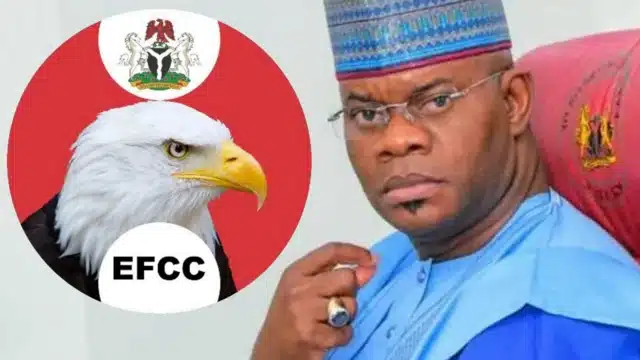
The Federal High Court in Abuja has set June 26 for its ruling on a controversial request by the Economic and Financial Crimes Commission (EFCC) to cross-examine its own witness, Nicholas Ojehomon, in the ongoing money laundering trial of former Kogi State Governor, Yahaya Bello.
Justice Emeka Nwite fixed the date after listening to arguments from both the EFCC and Bello’s defense team over the legality of the prosecution seeking to question a witness it had earlier called, following cross-examination by defense counsel, Joseph Daudu (SAN).
Tension arose when Daudu firmly opposed the EFCC’s attempt, stating that under the law, the prosecution could only re-examine its witness, not cross-examine him, unless the witness had been formally declared hostile.
When proceedings resumed, Daudu asked Ojehomon—an internal auditor at the American International School, Abuja—if he had testified in other court cases concerning school fees paid by the Bello family. Ojehomon said he had, but couldn’t recall the specific courts. He clarified that while he testified in a case involving Ali Bello, he never made any adverse statements against Yahaya Bello in either that case or the current one.
After Daudu’s cross-examination, EFCC counsel Olukayode Enitan (SAN) sought to cross-examine Ojehomon on Exhibit 19, a judgment document tendered by the defense. Enitan insisted he wasn’t re-examining the witness but cross-examining him since the exhibit had been introduced by the defense.
Daudu objected, calling the EFCC’s approach unprecedented and inconsistent with the Evidence Act. He argued that cross-examination of one’s own witness is only permissible when the witness is declared hostile.
Enitan countered, citing Section 36 of the Constitution on fair hearing, asserting the EFCC had the right to address parts of the document introduced by the defense. Justice Nwite asked for legal backing to support this claim.
Responding, Daudu maintained that the EFCC could not rely on fair hearing as a loophole to cross-examine its own witness without following due process.
Ultimately, Justice Nwite refused to allow the cross-examination and advised the EFCC to formally argue the matter before the court if they wished to pursue it further. He then scheduled June 26, 27, and July 4 and 5 for the ruling and further hearings.
During the session, Ojehomon also testified that no school fees were wired from the Kogi State government or its local governments to the American International School’s account. He referenced a previous FCT High Court ruling that found no evidence of any such funds being proceeds of money laundering or subject to forfeiture.



Comments
0 comments