
WADADA DID NOT DISCOVER THE PEOPLE FOUR MONTHS TO AN ELECTION
 Follow us on Google News
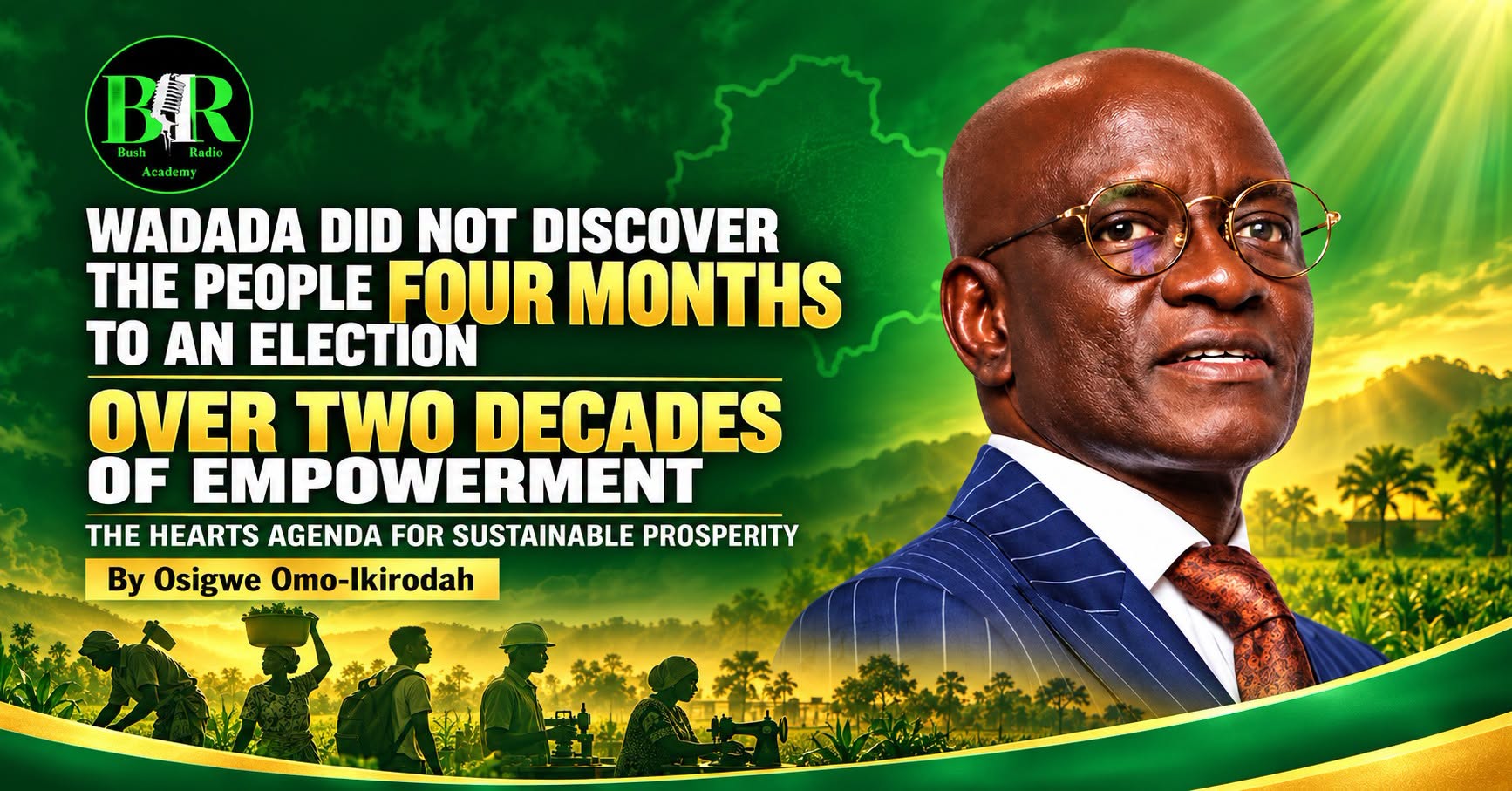
WADADA DID NOT DISCOVER THE PEOPLE FOUR MONTHS TO AN ELECTION
FOR MORE THAN TWO DECADES, HE HAS EMPOWERED, REPRESENTED AND STOOD WITH THE PEOPLE—NOW HIS HEARTS AGENDA OFFERS NASARAWA A PATH TO SUSTAINABLE PROSPERITY
By Osigwe Omo-Ikirodah
Something interesting is happening across Nasarawa State.
Politicians who were hardly known for touching ordinary lives have suddenly discovered empowerment.
Machines are being distributed. Grants are being announced. Meetings are being organised. Communities that were forgotten for years are suddenly receiving attention.
Empowerment is good. Any genuine effort that improves the life of one Nasarawa citizen should be welcomed.
But the people must ask one important question:
Why did this generosity begin only four months before an election?
An election should not be the alarm clock that wakes a politician to the suffering of the people.
True service is not an emergency performance staged when votes are approaching. It is a habit demonstrated consistently—whether an election is near or far, whether cameras are present or absent, and whether the beneficiary possesses any immediate political value.
That is the fundamental difference between Senator Ahmed Aliyu Wadada and those now attempting to compete with his record through hurried empowerment programmes.
WADADA’S EMPOWERMENT DID NOT BEGIN WITH THE 2027 ELECTION
For more than two decades, Wadada has remained connected to the people at the grassroots.
Long before the present governorship contest, his interventions had touched young people, women, farmers, artisans, students, community leaders and vulnerable families.
He did not wait until he needed their votes before recognising their difficulties.
As far back as 1991, he had founded the Association for Better Keffi as a vehicle for community development, civic participation and grassroots support. His journey of service continued through two terms in the House of Representatives, private-sector leadership and his present assignment as the senator representing Nasarawa West.
In May 2024—three years before the governorship election—Wadada empowered 586 women and youths with training and startup equipment. The beneficiaries included farmers, food processors, mechanics, welders, tailors and other small-scale entrepreneurs who required productive tools rather than political slogans.
That is what consistency looks like.
When a person has been investing in people for more than twenty years, his generosity cannot suddenly be dismissed as an election strategy.
But when politicians remember the poor only after electoral calculations have begun, the people are entitled to question both the timing and the motive.
HIS PERFORMANCE GOES BEYOND SHARING ITEMS
Wadada understands that sustainable empowerment must move beyond the periodic distribution of equipment.
A sewing machine may help one tailor. A grinding machine may support one household. A farming implement may increase the productivity of one farmer.
These interventions matter—but government must go further.
Government must create the roads that allow farmers to transport their produce.
It must provide electricity that enables small businesses to operate profitably.
It must improve schools so that the children of ordinary families can compete.
It must expand healthcare so that sickness does not destroy a household’s savings.
It must attract industries capable of employing thousands of young people.
And it must provide security so that farmers, traders and investors can work without fear.
This broader understanding is already reflected in Wadada’s legislative performance.
As Chairman of the Senate Committee on Public Accounts, he occupies one of the National Assembly’s most important accountability positions. His responsibility is not merely to speak—it is to scrutinise how public resources are used and demand answers where necessary.
His legislative interests have also addressed education, agriculture, fisheries, mineral development, investment and national productivity. They include proposals for a College of Agriculture and Fisheries in Umaisha and the upgrading of the Federal Polytechnic Nasarawa into a Federal University of Mining Engineering and Technology.
These are not random proposals. They reveal a consistent philosophy:
Nasarawa’s natural resources, young population and agricultural potential must be converted into knowledge, employment and lasting prosperity.
THE HEARTS AGENDA IS EMPOWERMENT ON A STATEWIDE SCALE
Wadada’s HEARTS Agenda represents the natural progression of his years of personal and constituency interventions.
It is the plan to move Nasarawa from helping hundreds of individuals periodically to building an economy capable of sustaining millions of residents continuously.
H — HUMAN CAPITAL DEVELOPMENT
No state can rise above the quality of its people.
The HEARTS Agenda prioritises education, healthcare, skills development, youth advancement, women’s inclusion and social protection.
E — ENERGY AND MINERAL RESOURCES
Nasarawa is richly endowed with solid minerals, yet mineral wealth must translate into better living conditions for the people.
Wadada’s vision is to encourage responsible mining, attract credible investors, strengthen local participation and expand energy access to communities and industries.
The true value of Nasarawa’s minerals should not be measured only by what leaves the ground. It must also be measured by the jobs created, businesses supported, revenue generated and communities developed.
A — AGRICULTURE AND GREEN ECONOMY
Thousands of Nasarawa families depend on agriculture, but many farmers still struggle with inadequate inputs, poor rural roads, limited irrigation, weak storage facilities and restricted access to markets.
The HEARTS Agenda seeks to modernise agriculture through mechanisation, improved inputs, irrigation, processing, storage and stronger connections between farmers and buyers.
Instead of merely giving a farmer temporary assistance, the goal is to build an agricultural system in which farming becomes profitable, productive and attractive to young people.
R — RURAL AND URBAN DEVELOPMENT
Development must not stop in Lafia, Keffi or other major towns.
Rural communities also deserve accessible roads, clean water, healthcare facilities, functional schools, housing and economic opportunities.
Balanced development will reduce rural poverty, control unplanned urban congestion and ensure that no part of Nasarawa is abandoned because of its population, ethnicity, religion or political preference.
T — TRADE, INVESTMENT AND INDUSTRY
Nasarawa’s proximity to the Federal Capital Territory is an enormous economic advantage.
Under the HEARTS Agenda, that advantage can be converted into industrial growth, expanded markets, support for small and medium-sized businesses, stronger investment promotion and thousands of new jobs.
This is where Wadada’s private-sector, administrative and legislative experience becomes important.
He understands that government does not have to employ everybody directly. But government must create the environment in which businesses can grow, industries can invest and citizens can build dignified livelihoods.
S — SECURITY
No development plan can succeed where people are afraid to travel, farm, trade or invest.
The HEARTS Agenda therefore places security at the centre of governance through stronger community intelligence, modern surveillance, rapid-response capacity, inter-agency cooperation and sustained peacebuilding.
Security is not merely about arresting criminals after an attack. It is about building systems that prevent attacks, protect communities and give citizens confidence in their government.
The six pillars form a practical framework for inclusive growth and measurable development across Nasarawa State.
NASARAWA MUST DISTINGUISH CHARITY FROM CAPACITY
The approaching election is not simply about who can distribute the greatest number of items within four months.
It is about who possesses the experience, structure, credibility and economic vision required to manage an entire state.
A hurried empowerment programme may produce photographs.
A carefully designed economic programme produces jobs, industries, stronger institutions and lasting livelihoods.
WADADA’S RECORD CANNOT BE RECREATED IN FOUR MONTHS
Those now jumping from community to community are free to continue empowering the people. Nasarawa needs every genuine intervention it can receive.
But they should not expect the electorate to forget the years when they had the opportunity to serve and remained distant.
They cannot compress more than two decades of grassroots relationships into four months.
They cannot manufacture consistency on the eve of an election.
They cannot distribute enough items to erase Wadada’s history of standing with the people.
Wadada’s strongest political asset is not merely the size of his campaign organisation.
It is memory.
The people remember who stood with them before the governorship ticket.
They remember who remained accessible when no election was approaching.
They remember who invested in their ambitions, defended their interests and carried their concerns into national institutions.
And now, through the HEARTS Agenda, that long record of personal commitment is being transformed into a comprehensive programme for the whole state.
Others may have recently discovered empowerment.
Wadada has made it a lifetime commitment.
Others are responding to an election timetable.
Wadada is presenting a development timetable.
The choice before Nasarawa is therefore not between competing political promises.
It is between temporary election-season gestures and a proven lifetime of service backed by a practical plan for sustainable prosperity.
Wadada has stood with the people for more than two decades.
With the HEARTS Agenda, he is ready to build a Nasarawa where the people will not depend permanently on political empowerment—because education, agriculture, energy, infrastructure, investment and security will give them the power to sustain themselves.
Osigwe Omo-Ikirodah is the Principal and CEO of Bush Radio Academy





Comments
0 comments