
2027 Presidency: Opposition Parties Begin Fresh Push For Single Candidate
 Follow us on Google News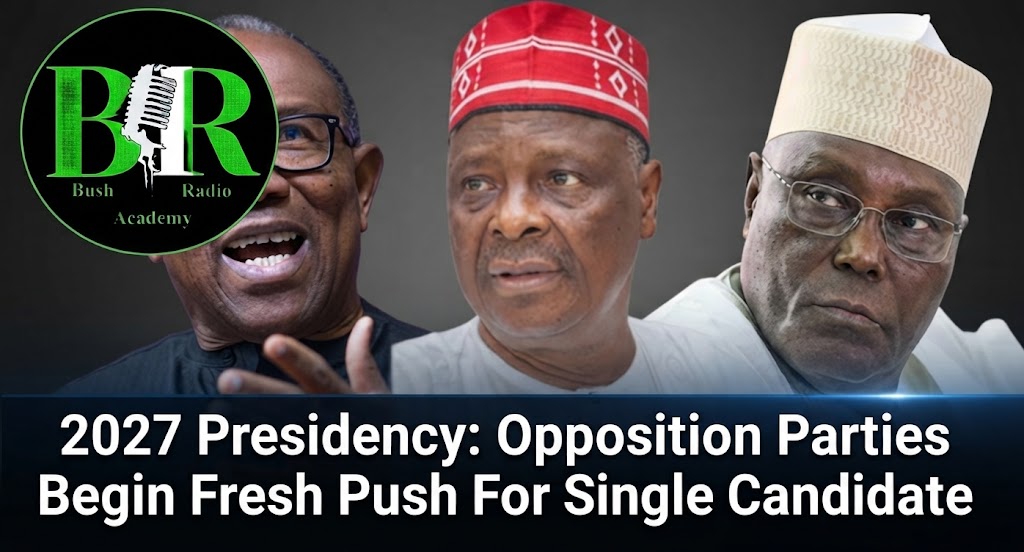
Opposition political parties have taken a major step towards presenting a consensus presidential candidate for the 2027 general election, with five specialised committees established to develop a framework for achieving the objective.
The committees, inaugurated at a political meeting in Abuja, are expected to work on the National Covenant for Democratic Renewal, Single-Term Transition Charter, National Reform Programme, Framework for Opposition Unity, and Roadmap to a Common Presidential Candidate.
The committees have been given 30 days to submit their reports, which are expected to form the basis for further consultations among the opposition parties. According to a communiqué issued after the meeting, the submission of the reports will pave the way for a second consultative gathering, although no date has been announced.
The meeting was convened by the civil society pressure group, G-100, in collaboration with the Minority Caucus of the House of Representatives. Discussions centred on the possibility of opposition parties working together to produce a common presidential candidate and establish a four-year transition government.
However, some of the major political figures expected at the gathering were absent. Former Vice President Atiku Abubakar of the African Democratic Congress and Peter Obi of the Nigeria Democratic Congress did not attend the meeting. Their respective running mates, Rotimi Amaechi and Rabiu Kwankwaso, were also absent after previously indicating that they would not participate in the summit.
Despite the absence of the prominent presidential contenders, several opposition figures attended the meeting, including Social Democratic Party presidential candidate Adewole Adebayo and his running mate, Usman Bugaje; Peoples Redemption Party presidential candidate Donald Duke; Democratic Leadership Alliance candidate Moses Olusola; and Allied Peoples Movement vice-presidential candidate Lawal Daura.
Speaking on the outcome of the meeting, House Minority Caucus leader Afam Ogene said participating parties had agreed to pursue a structured negotiation process ahead of the 2027 election.
He said the parties recognised the need to move beyond individual political interests and cooperate in addressing major national challenges, including insecurity, rising living costs and unemployment.
The meeting also produced three standing coalition organs to coordinate the proposed alliance. They include a central leadership committee to act as the political arbiter, a publicity and communication committee responsible for joint messaging, and a legal committee tasked with preparing the necessary constitutional and legal documents.
G-100 Director-General and former Director-General of the Progressives Governors’ Forum, Salihu Lukman, warned that continued division among opposition parties could strengthen the ruling All Progressives Congress ahead of the 2027 election.
Lukman urged opposition leaders to concentrate on establishing clear procedures for cooperation rather than allowing disagreements over individual candidates to derail the coalition process.
According to Bush Radio Academy, he noted that the opposition had repeatedly contested presidential elections separately, a situation that allowed the ruling party to benefit from divided opposition votes.
House Minority Leader Frederick Agbedi similarly called on political leaders to prioritise the economic difficulties facing Nigerians over personal political ambitions. He maintained that a united opposition could replicate the political breakthrough achieved by the APC in 2015.
ADC National Vice-Chairman (South-South), Usani U. Usani, also urged opposition parties to intensify efforts to defeat the APC in 2027, describing the coalition project as a “now or never” opportunity.
PRP National Chairman Hakeem Baba-Ahmed stressed that no single opposition party could defeat the APC on its own, while former Niger State Governor Babangida Aliyu criticised what he described as the long-standing dominance of personal and financial interests over national priorities.
Aliyu called on the G-100 leadership to extend the initiative to the state and local government levels so that party members and supporters at the grassroots could become part of the process.
SDP National Chairman Sadiq Gombe also described the political situation as requiring an urgent national rescue effort, noting that opposition candidates collectively secured more than two-thirds of the votes cast in the 2023 presidential election.
The latest development signals an intensified effort by opposition parties to overcome their longstanding divisions and establish a united political platform ahead of the 2027 presidential election.


Comments
0 comments