
Latest
Rivers Crisis Deepens: Why The Wike–Fubara Peace Pact Finally Collapsed

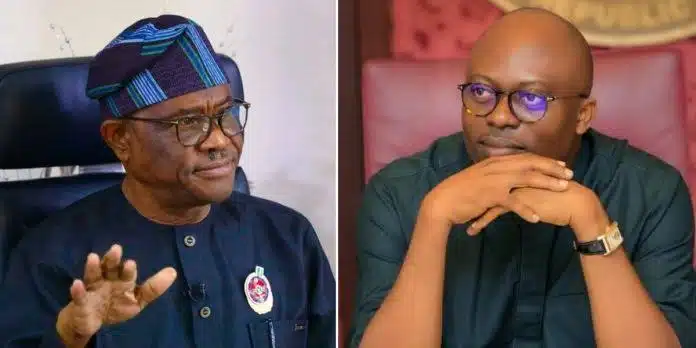
Political tensions in Rivers State have flared up once again as the State House of Assembly resumed impeachment proceedings against Governor Siminalayi Fubara and his deputy, Professor Ngozi Oduh.
This development marks the third impeachment attempt against Fubara in less than three years, underscoring the deepening political instability in the state. The crisis has been further intensified by the governor’s recent defection to the All Progressives Congress (APC), which has significantly altered the state’s political landscape.
The renewed impeachment process is anchored on allegations of gross misconduct and financial irregularities, with lawmakers outlining eight separate charges against the governor. The allegations were formally presented during plenary by the Majority Leader of the House, Major Jack.
According to the accusations, Fubara engaged in reckless and unconstitutional spending of public funds, unlawfully misappropriated state resources, obstructed the legislature from carrying out its constitutional duties, and made appointments without the required screening and approval of the Assembly. He was also accused of withholding salaries and allowances meant for lawmakers.
Additional claims include the alleged seizure of the salary of the Clerk of the House, Emeka Amadi, refusal to implement constitutional provisions guaranteeing financial autonomy for the legislature and judiciary, and the withholding of funds allocated to the Rivers State House of Assembly Service Commission, reportedly disrupting its operations.
The latest action comes despite multiple peace efforts brokered by President Bola Ahmed Tinubu to ease tensions in the state, including interventions in December 2023 and again in 2025.
In March 2025, President Tinubu declared a state of emergency in Rivers State following an earlier impeachment move by the Assembly, suspending the governor, his deputy, and the lawmakers. Former Chief of Naval Staff, Ibok-Ete Ibas, was appointed as administrator during the emergency period.
Before the emergency rule elapsed, the president facilitated reconciliation among the major political actors, leading to Fubara’s reinstatement. However, Thursday’s development suggests that the most recent truce has collapsed.
Fubara’s defection to the APC in December 2025 has further reshaped power dynamics in Rivers State, diminishing the political influence of the Minister of the Federal Capital Territory, Nyesom Wike, long regarded as the dominant force in the state’s politics.
Political analysts interpret the Assembly’s latest move as part of an ongoing struggle for control, particularly as Fubara’s second-term ambitions come into focus.
Sources allege that the crisis escalated after lawmakers loyal to Wike pushed for a supplementary budget, which the governor declined to approve, citing the N1.48 trillion budget passed during the period of emergency rule.
Following the alleged rejection of the supplementary budget, Wike was said to have convened a meeting with political allies, including members of the Assembly, at the Port Harcourt residence of elder statesman Ferdinand Anabraba, in an attempt to reassert his political influence.
Insiders claim that Fubara, perceiving a growing threat to his authority, hastened his alignment with the APC as a strategic move to counterbalance Wike’s influence. One source noted that bringing Fubara into the APC was viewed as a way to weaken Wike’s political leverage.
The governor was also accused of abandoning earlier agreements that allegedly required him to reinstate Sergeant Awuse as chairman of the state’s traditional rulers’ council and to appoint new commissioners. According to sources, Fubara believed these conditions would severely undermine his authority.
At the Assembly, Speaker Martins Amaewhule accused the governor of persistently undermining the legislature, citing his failure to present the 2026 appropriation bill, a move described as critical to governance.
Amaewhule further alleged that Fubara had disparaged the Assembly by referring to it as a “toothless bulldog” and had sought presidential intervention to weaken the legislature’s authority.
He maintained that the impeachment process was primarily driven by the governor’s refusal to present a budget and alleged spending outside the appropriation law, stressing that the House would allow due process to run its course.
The Speaker also argued that the governor’s belated attempt to present the budget or Medium-Term Expenditure Framework should not derail the investigation, insisting that Fubara had ample time to fulfil his constitutional obligations.
Amaewhule described the governor’s administration as a failure, claiming that Rivers State had never experienced such governance challenges and noting that Fubara and his deputy were the only sub-national officeholders yet to present a 2026 budget nationwide.
He added that several meetings involving President Tinubu and Nyesom Wike had previously been held to resolve the crisis, but failed to produce lasting peace.
Political observers contend that beyond the allegations of misconduct, the impeachment push is closely linked to Fubara’s defection to the APC, which has shifted the balance of power in Rivers State and significantly weakened Wike’s hold on the state’s political machinery.


Fresh Warning For Foreigners As Denmark Blocks Access To 5 Social Benefits

MO3 Murder: Gunman Found Guilty Of Capital Murder In Shocking Verdict

Rivers Assembly Under Probe Over Alleged Govt Funding Of PUMS

Isabell Idibia Breaks Silence On Annie’s Close Bond With Swanky Jerry

Banditry Allegations Rock Bauchi Senator As Shehu Buba Breaks Silence

WHY OKPEBHOLO KNOWS WHAT HE IS SAYING ABOUT TINUBU’S 2.5 MILLION VOTES

THE 18,439-VOTE MISSION WHY WADADA COULD BE TINUBU’S NASARAWA GAME CHANGER

Fake Agency Scandal: ICPC Recommends Punishment for 13 Officials — See Full List

Cement Hits ₦15,000: FCCPC Demands Answers From Dangote, BUA, Other Producers
