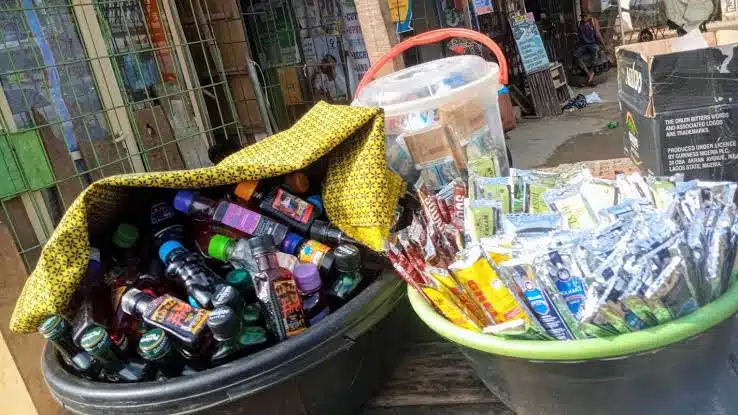
Speaking on Friday during an interview on Arise News, the Director-General of NAFDAC, Professor Mojisola Adeyeye, stressed that the health and safety of children must take precedence over commercial interests.
She explained that the agency’s action is aimed at safeguarding young people from the dangers of early alcohol exposure and preventing future addiction, noting that the policy is fundamentally about protecting public health.
“So it is on their side that they are all about money, not about health. We are about health and good investments… But we cannot sacrifice our children on the altar of trade,” she said.
Adeyeye clarified that NAFDAC is not banning alcohol entirely, but only restricting its sale in small, easily accessible packages.
“We are not banning alcohol. We approve alcohol in different packages. It is only in small packages that we are banning,” she stated.
No Court Order Halting Enforcement
During the interview, the NAFDAC boss also dismissed claims that a court order had stopped the enforcement of the sachet alcohol ban.
She maintained that the agency has not been served with any such directive.
“NAFDAC has not been served. If we have been served, I have not been given that,” she said.
Adeyeye added that the renewed enforcement was backed by legislative support.
“The Senate gave us the order to resume enforcement,” she noted.
Policy Dates Back to 2018
Tracing the origin of the policy, Adeyeye recalled that in 2018, NAFDAC raised concerns over sachet alcohol products containing between 43 and 45 per cent alcohol content.
She explained that an agreement was reached with manufacturers, under the supervision of the Federal Ministry of Health, granting them five years to phase out sachet packaging.
“That can be easily squeezed into the pocket of a primary school, secondary school child,” she said.
“We all signed that by, after five years, they will not sell alcohol in sachets.”
When the initial deadline expired on January 31, 2024, Adeyeye said an extension was granted following interventions from lawmakers and industry stakeholders.
The extended moratorium, however, ended in December 2025.
“The Minister called me… we should give one year moratorium… and that one year expired December 2025,” she explained.
Despite calls from manufacturers for further extensions, enforcement resumed based on the Senate’s directive.
Warning Labels Not Enough
Adeyeye rejected suggestions that warning labels could effectively curb underage drinking, describing such measures as unrealistic in the Nigerian context.
“Do not use under 18… are we kidding ourselves? In Nigeria? Who is going to enforce?” she asked.
She also noted that the ban aligns with Nigeria’s international commitments under the World Health Assembly agreement signed in 2010, which seeks to reduce alcohol accessibility to vulnerable groups.
Accessibility Fuels Addiction
Addressing arguments that alcohol concentration could simply be reduced instead of banning sachets, Adeyeye insisted the major issue is the small pack size, which makes alcohol cheap, concealable, and easily accessible.
She revealed disturbing reports of alcohol abuse among schoolchildren.
“The principal said that in his school, a student said that he cannot study for exam without a sachet alcohol,” she said.
“We are making our children addicts. Addicts.”
She further warned of the long-term health effects of alcohol consumption, including gradual liver damage.
Production Lines Shut, Not Companies
Adeyeye clarified that NAFDAC is not shutting down entire companies but only closing production lines dedicated to sachet alcohol packaging.
“Lines have been shut down… We are shutting down lines,” she said.
She added that manufacturers have been consistently engaged through regular meetings, including quarterly discussions with the Manufacturers Association of Nigeria (MAN), leading up to the renewed enforcement.