Connect with us

Latest

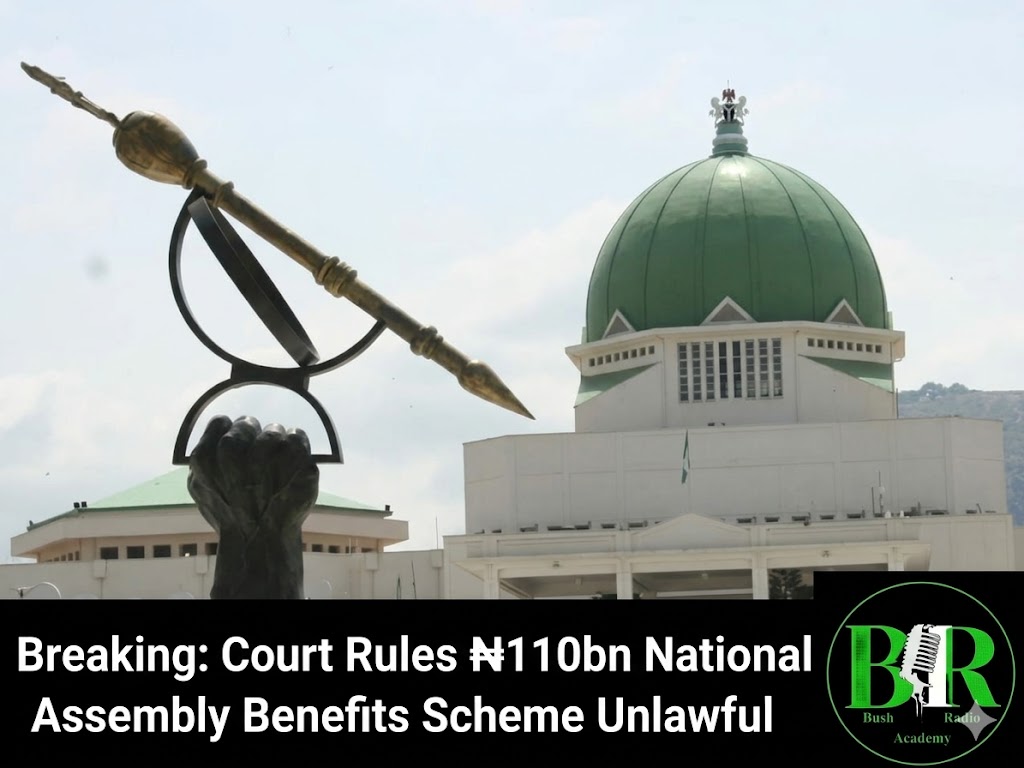
Breaking: Court Rules ₦110bn National Assembly Benefits Scheme Unlawful

Published

on

The Federal High Court sitting in Lagos has declared illegal the National Assembly’s controversial ₦110 billion vehicle procurement and lawmakers’ allowance scheme.....KINDLY READ THE FULL STORY HERE▶

In a judgment delivered on Wednesday, May 6, 2026, Justice Yellim Bogoro held that the spending of ₦40 billion on 465 vehicles for lawmakers and another ₦70 billion for support allowances for newly elected legislators violated procurement regulations, constitutional provisions, and public trust principles.

The case was instituted by the Socio-Economic Rights and Accountability Project (SERAP) against the leadership of the National Assembly.

The court also directed Senate President Godswill Akpabio and Speaker of the House of Representatives Tajudeen Abbas to ensure that all future National Assembly expenditures strictly comply with due process, transparency, accountability, and value-for-money principles.

A certified true copy of the judgment was obtained on Sunday.

SERAP, through its deputy director Kolawole Oluwadare, said the suit was filed in August 2023 after reports emerged that the National Assembly planned to spend ₦40 billion on vehicles and ₦70 billion on allowances for new lawmakers, despite worsening economic conditions in the country.

Delivering judgment, Justice Bogoro described the expenditure as arbitrary, excessive, and inconsistent with statutory procurement standards, noting the absence of proper due process.

The judge also raised concerns over conflict of interest, observing that the beneficiaries of the expenditure were the same officials approving it.

She further noted that the scale of the spending was unjustifiable in light of Nigeria’s economic hardship, stressing that public funds must be prioritised in the national interest.

Justice Bogoro rejected arguments that the court lacked jurisdiction due to legislative autonomy, holding that separation of powers does not protect unlawful conduct.

She emphasised that the court’s duty was to examine the legality and constitutionality of legislative spending, not to interfere with legislative independence.

The judge also held that public office must not be used for personal enrichment and that officials are bound by constitutional limits and the oath of office.

Addressing the issues raised by the defendants, the court ruled that SERAP had the legal standing to institute the case, recognising the role of public interest litigation and civil society organisations in promoting accountability.

On the issue of pre-action notice, the court held that while such notice is generally required, exceptions exist in cases involving urgency, public interest, or fundamental rights.

The court further dismissed objections that the case had become academic or that it constituted an abuse of court process, ruling that the matter raised live constitutional questions.

Justice Bogoro concluded that SERAP had successfully demonstrated that the planned expenditure of ₦110 billion violated provisions of the Public Procurement Act, the Constitution, and the Code of Conduct for Public Officers.

The defendants had argued that the funds were already spent and that the suit was based on media reports, but the court held that constitutional interpretation was still necessary regardless of completion of the transaction.

The ruling also confirmed that legislative immunity does not extend to acts that are unlawful or unconstitutional, affirming the court’s power to intervene where public funds are mismanaged.

Advertisement
Click to comment

Leave a Reply

Your email address will not be published. Required fields are marked *