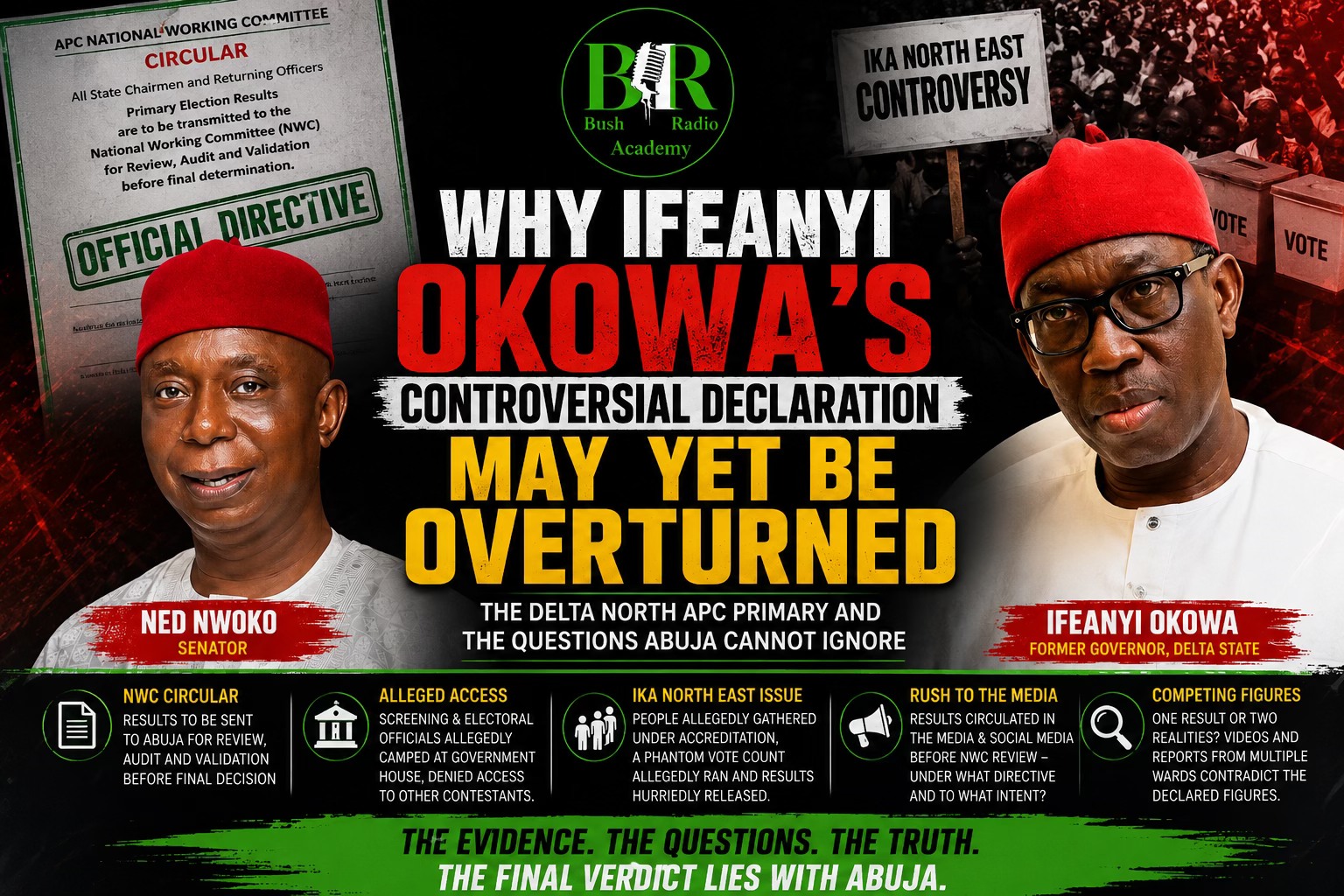
Why Ifeanyi Okowa’s Controversial Declaration May Not Survive Abuja’s Final Review
In every democracy, primary elections are designed to achieve one objective: allow party members to determine who flies the party’s flag.....KINDLY READ THE FULL STORY HERE▶
Yet history has shown that primary elections are often where the fiercest political battles occur.
The integrity of a primary election must not only be protected.
It must be seen to have been protected.
It is against this backdrop that the controversy surrounding the Delta North APC Senatorial Primary deserves serious examination.
While the Delta State chapter of the APC announced former Governor Ifeanyi Okowa as the winner of the exercise, the circumstances surrounding that declaration have generated questions that have refused to disappear.
Indeed, the more information that emerges from party members, stakeholders, and participants, the more evident it becomes that the matter may be far from settled.
The issue is not merely that Senator Ned Nwoko rejected the declaration.
Political contestants reject outcomes every day.
The issue is the nature of the allegations, the procedural concerns raised, and the growing body of evidence being cited by those challenging the outcome.
Taken together, they present a picture that the APC National Working Committee may find difficult to ignore.
One of the most significant aspects of the controversy relates to directives reportedly issued by the APC National Working Committee before the conduct of the primaries.
According to information widely circulated among stakeholders, officials overseeing the exercise across the federation were instructed that results from the primaries should be transmitted to Abuja for review and validation.
The logic behind such a directive is obvious.
National review exists precisely to identify anomalies, examine complaints, reconcile discrepancies, and ensure that the final outcome reflects the genuine will of party members.
It serves as a safeguard against local distortions and procedural irregularities.
If that directive was indeed issued, then an obvious question arises.
Why did figures from Delta North appear to be hurriedly projected into the media and social media space before the completion of the national review process?
Under whose authority were such figures promoted?
For what purpose?
And perhaps most importantly, what was the urgency?
Political communication is rarely accidental.
Those familiar with political strategy understand that perception often becomes reality.
Once a narrative takes root in the public space, any subsequent review or correction is frequently portrayed as an attempt to overturn an established outcome.
This is precisely why timing matters.
It is also why the National Working Committee may have to carefully examine not just the figures themselves but the circumstances under which those figures were projected.
Then there is the question of neutrality.
Among the allegations advanced by the Ned Nwoko camp is the claim that certain officials associated with the electoral and screening process were allegedly camped at Government House and were reportedly inaccessible to other contestants and stakeholders.
At the same time, it is alleged that the camp of the declared winner enjoyed unrestricted access to those same officials.
Whether these allegations are ultimately substantiated remains for investigators to determine.
However, from an electoral governance perspective, the issue extends beyond proof.
It concerns perception.
The credibility of any electoral process depends heavily on public confidence in the neutrality of those entrusted with administering it.
Even the appearance of unequal access raises legitimate concerns.
When contestants begin questioning the independence of officials before voting has even commenced, confidence in the process inevitably comes under strain.
Perhaps nowhere are those concerns more visible than in the controversy surrounding events in Ika North East.
Interestingly, much of the public defence of the controversial declaration appears to rely heavily on activities that allegedly occurred in that particular ward.
Yet Delta North consists of approximately 98 wards.
This immediately creates a fundamental credibility question.
Can the political strength of an entire senatorial district be established through events in a single ward?
If the declaration accurately reflected overwhelming support across Delta North, why has the public conversation become so heavily dependent on one ward?
Where is the corresponding evidence from the remaining wards?
Where are the videos?
Where are the records?
Where are the demonstrations of similar support across the district?
These questions become even more important when viewed alongside allegations emerging from participants regarding what transpired in Ika North East.
According to multiple accounts from APC members sympathetic to Senator Ned Nwoko, individuals were allegedly assembled under the guise of accreditation before voting.
What followed, they contend, was not a straightforward voting process but a sequence of events that allegedly created a visual impression of overwhelming support.
Their claim is that accreditation queues were effectively transformed into what critics now describe as a phantom counting exercise.
In essence, they argue that a process intended for one purpose was subsequently used to support a different narrative altogether.
Again, these remain allegations.
But they are allegations that go directly to the integrity of the process.
Beyond these procedural concerns lies another challenge that the National Working Committee may find difficult to overlook.
The challenge of competing realities.
The declaration announced by the Delta State chapter suggests that Senator Ned Nwoko secured only 2,612 votes.
Yet videos continue to emerge from multiple communities and wards across Delta North showing substantial mobilisation, participation, celebrations, and visible support for the senator.
No serious observer would argue that videos alone determine election outcomes.
They do not.
However, evidence must be considered collectively.
When visual evidence, participant testimonies, and alternative result claims appear fundamentally inconsistent with officially announced figures, questions naturally arise.
Those questions become even more significant when one considers the alternative figures now being advanced by the Nwoko camp.
According to supporters of the senator, the actual outcome produced approximately 123,000 votes for Ned Nwoko and roughly 6,000 votes for Ifeanyi Okowa.
Whether those figures are accurate is ultimately a matter for the APC National Working Committee.
But the sheer distance between those claims and the controversial declaration underscores why this issue cannot simply be dismissed as routine post-election dissatisfaction.
The discrepancy is too substantial.
The implications are too serious.
And the political consequences are too significant.
Ultimately, the issue before the APC National Working Committee is not whether one candidate should be preferred over another.
The issue is whether the process that produced the controversial declaration can survive scrutiny.
The responsibility of the NWC is not to protect declarations.
Its responsibility is to protect legitimacy.
If the allegations are unfounded, a transparent review will expose them.
If the complaints lack merit, a transparent review will expose that as well.
But if genuine irregularities exist, then the party’s credibility demands that they be confronted honestly.
For now, one conclusion appears unavoidable.
The controversial declaration may have been announced.
But the final political verdict on the Delta North APC Senatorial Primary may still be awaiting determination in Abuja.
And until that process is completed, the debate is unlikely to disappear.
Osigwe Omo-Ikirodah is the Principal and CEO of Bush Radio Academy.