
Latest
Nigeria Can Beat Poverty’ — Peter Obi Reveals Game-Changing Rescue Plan

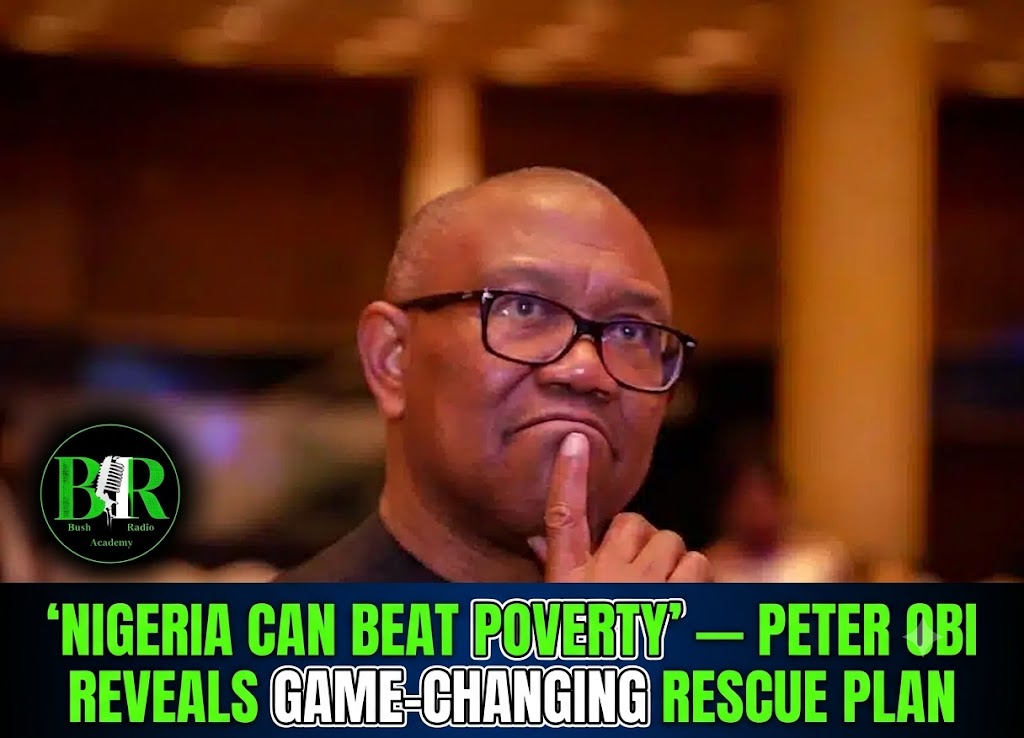
The presidential candidate of the Nigeria Democratic Congress (NDC), Peter Obi, has unveiled an economic blueprint aimed at transforming Nigeria from a consumption-based economy into one driven by production, agriculture, manufacturing and entrepreneurship.
Speaking during an appearance on Channels Television’s Sunday Politics, Obi said Nigeria possesses the land, natural resources and workforce needed to become a leading producer of food and industrial goods if the right economic policies are adopted.
According to the former Anambra State governor, the country’s rising poverty, unemployment and sluggish economic growth can only be reversed by boosting local production instead of relying heavily on imports.
“The only sustainable way to reduce poverty and grow the economy is through production, not consumption,” Obi said. “Agriculture provides food, creates jobs and supplies raw materials for industries. It is the foundation of economic development.”
Agriculture as the Economic Engine
Obi said agriculture would be a cornerstone of his administration’s economic agenda, arguing that Nigeria has the potential to generate more income from farming and agro-processing than it currently earns from crude oil exports.
He lamented that millions of hectares of fertile land remain uncultivated while the country spends huge sums importing food that could be produced locally.
“Nigeria can feed itself and export agricultural products. We have vast arable land that remains underutilised,” he stated.
Using rice production as an example, Obi said Nigeria has failed to maximise its agricultural potential because of years of dependence on imported food.
“We destroyed our local farming sector by encouraging cheap imports instead of supporting our farmers,” he added.
Drawing comparisons with Bangladesh, Obi noted that the Asian nation produces between 15 and 16 million tonnes of unmilled rice annually despite having a smaller landmass than Nigeria.
He argued that with investments in mechanised farming, irrigation, storage facilities and modern agricultural practices, Nigeria could surpass such production levels.
Lessons from Other Countries
Obi pointed to the Netherlands as proof that agriculture can become a major source of national revenue.
According to him, the European country earns more than €120 billion annually from agricultural exports despite having significantly less land than Nigeria.
“The Netherlands makes over €120 billion every year from agricultural exports, which is several times more than Nigeria earns from oil,” he said.
He also referenced Ethiopia, Kenya and Morocco, saying they have successfully developed export-oriented agricultural industries.
“Ethiopia earns substantial foreign exchange from coffee, while Kenya has built a thriving flower export market. Nigeria has similar opportunities if we invest properly,” Obi said.
Security Remains Critical
Obi stressed that agricultural development cannot succeed without restoring security across farming communities.
He noted that insecurity has forced many farmers to abandon fertile lands, particularly in states with enormous agricultural potential.
Using Niger State as an example, Obi said the state’s rich farmland remains largely inaccessible because of terrorist activities.
“Niger State has enormous agricultural potential, but insecurity has prevented farmers from making full use of the land,” he observed.
He also highlighted the Sambisa Forest, suggesting it could eventually be transformed into productive farmland once security is restored.
“Sambisa covers about 60,000 square kilometres—roughly twice the size of Belgium. With peace and proper investment, such land could become highly productive,” he said.
Obi further identified Taraba State and the Mambilla Plateau as ideal locations for cultivating export crops such as tea and coffee.
Reviving Manufacturing
Beyond agriculture, Obi said rebuilding Nigeria’s manufacturing sector would be essential to creating a stronger economy.
He argued that the country must stop exporting raw materials and instead process them locally to increase value, create jobs and improve export earnings.
“A strong economy requires a vibrant manufacturing sector. We must process what we produce instead of exporting raw materials,” he said.
Backing Small Businesses
Obi also pledged greater support for entrepreneurs and small businesses, insisting that government should focus on creating a business-friendly environment rather than directly engaging in production.
“I have never suggested that government should be the producer. Government’s responsibility is to create the right conditions for the private sector to thrive,” he said.
He explained that small and medium-sized enterprises (SMEs), which generate millions of jobs in many successful economies, continue to struggle in Nigeria because of limited access to affordable financing, poor infrastructure and inadequate business support.
Referencing Indonesia and China, Obi said government-backed funding and skills development have enabled SMEs in those countries to become major employers.
“You cannot expect small businesses to survive when borrowing costs are as high as 35 per cent and there is little institutional support,” he said.
Gradual Reduction of Food Imports
Obi ruled out imposing an immediate ban on food imports, saying such a move would only be practical after Nigeria significantly boosts domestic agricultural production.
He cited countries such as India and Vietnam, which gradually reduced dependence on imported food before becoming major agricultural exporters.
While acknowledging that transforming Nigeria into a production-led economy would take time, Obi said consistent progress would restore confidence among citizens.
“No nation changes overnight. What matters is laying the right foundation and allowing people to see tangible progress,” he said.
Obi maintained that by improving security, expanding agriculture, revitalising manufacturing and making credit more affordable for businesses, Nigeria could create jobs, reduce poverty and build a more competitive economy.


Oshiomhole Reveals Why Peter Obi Sh*cked Tinubu In Lagos During 2023 Election

Fresh Diplomatic Twist: Reason Tinubu Declined Ramaphosa Envoy’s Meeting Revealed

Abacha Debate Takes New Twist As Ex-DSS Chief Demands CCTV Proof From Al-Mustapha

Fresh Twist: Nigerian Army Ordered To Reinstate 70 Soldiers Granted Presidential Pardon By Buhari

Fresh Twist: Ejiofor Says He No Longer Represents Nnamdi Kanu, Remains IPOB Lawyer

Fear Grips Kidnappers, Bandits as Okpebholo Deploys 497 Forest Guards Across Edo

Fresh Details Emerge On Operation That Led To PFIPC ‘Fake DG’ Adeyemi’s Arrest

El-Rufai’s Medical Report Sparks Fresh Crisis As MDCAN Probes Doctor, ICPC Files Charges

Why Is It Not Implemented?’—Lawmaker Blasts FG Over 2025 Budget Delay
