
Latest
FG Borrowing Soars 61% To ₦12.62 Trillion As Revenue Crisis Deepens

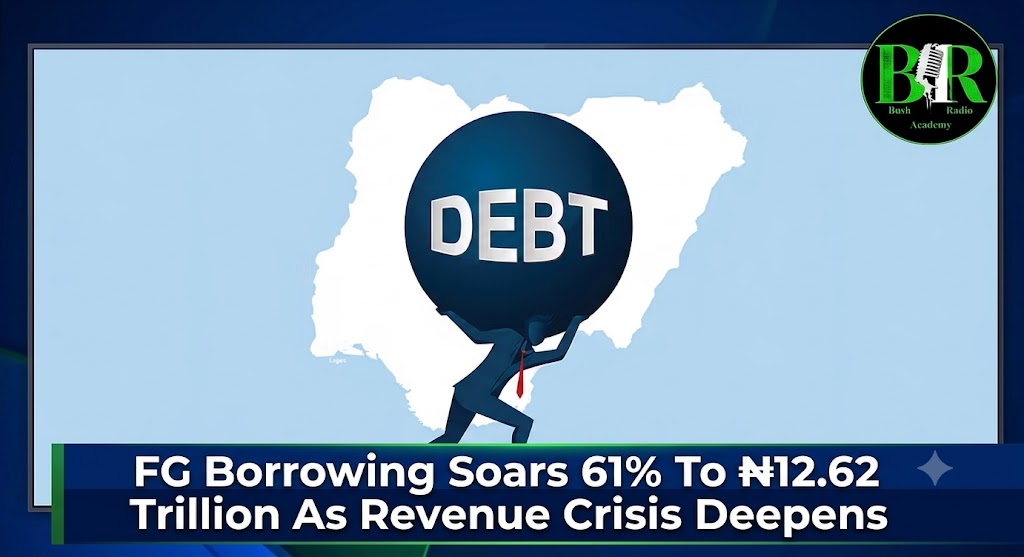
The Federal Government exceeded its 2024 borrowing target by ₦4.79 trillion after weaker-than-expected revenue forced it to rely more heavily on debt to finance government operations.
This is according to the Fourth Quarter and Consolidated Budget Implementation Report for 2024 released by the Budget Office of the Federation.
The report showed that the government borrowed a total of ₦12.62 trillion during the year, surpassing the approved borrowing plan of ₦7.83 trillion by 61.2 per cent.
The higher borrowing was driven by a widening fiscal deficit, which rose to ₦13.51 trillion—well above the ₦9.18 trillion projected in the 2024 budget.
Revenue Misses Target by ₦4.9 Trillion
According to the Budget Office, the Federal Government generated ₦20.98 trillion in revenue in 2024, falling ₦4.90 trillion short of its ₦25.88 trillion target.
Government expenditure, however, remained largely within budget, amounting to ₦34.49 trillion compared to the approved ₦35.06 trillion, a difference of just ₦561.29 billion.
The report concluded that the larger fiscal deficit was primarily caused by lower-than-expected revenue rather than excessive government spending.
“The revenue and expenditure outturn of the Federal Government resulted in a fiscal deficit of ₦13.51 trillion in the 2024 fiscal year. This was ₦4.34 trillion (47.33 per cent) above the projected budget deficit estimate for the year,” the report stated.
The deficit also exceeded the ₦10.55 trillion recorded in 2023, reflecting mounting pressure on Nigeria’s public finances.
Borrowing Surpasses Approved Plan
An analysis of the government’s financing profile showed that domestic borrowing remained within the approved limit at ₦6.06 trillion.
However, foreign borrowing rose sharply from the projected ₦1.77 trillion to ₦3.37 trillion.
In addition, the government secured ₦3.19 trillion in budget support despite the absence of any provision for such funding in the 2024 budget.
Combined, domestic loans, external borrowing and budget support increased total borrowing to ₦12.62 trillion, exceeding the approved plan by ₦4.79 trillion.
The report further revealed that newly acquired debt financed about 36 per cent of the Federal Government’s total expenditure in 2024, underscoring the country’s continued reliance on borrowing.
Project-tied multilateral and bilateral loans also climbed to ₦1.98 trillion, nearly double the ₦1.05 trillion budgeted for the year.
Meanwhile, the government failed to realise its projected ₦298.49 billion from privatisation proceeds, as no asset sales were completed during the period.
Oil Revenue Falls Short
The Budget Office attributed much of the financing gap to weaker oil earnings.
Gross oil revenue stood at ₦15.07 trillion, missing the budget target by ₦4.93 trillion.
Average crude oil prices settled at $74.65 per barrel, below the budget benchmark of $77.96, while average daily production reached 1.54 million barrels, falling short of the projected 1.78 million barrels per day.
In contrast, non-oil revenue outperformed expectations.
Collections from Company Income Tax, Value Added Tax, the Electronic Money Transfer Levy and Customs boosted non-oil revenue to ₦16.09 trillion, exceeding the ₦10.81 trillion target by ₦5.29 trillion.
Debt Servicing Continues to Rise
The report also highlighted a sharp increase in debt servicing costs.
Total debt service expenditure reached ₦12.36 trillion, exceeding the ₦8.27 trillion budget by 52.71 per cent.
Capital project implementation also lagged, with only ₦3.27 trillion utilised by Ministries, Departments and Agencies despite ₦5.81 trillion being released and cash-backed for capital expenditure as of June 30, 2025.
Public Debt Climbs to ₦144.67 Trillion
Nigeria’s total public debt rose to ₦144.67 trillion by the end of December 2024, pushing the country’s debt-to-GDP ratio to 61.22 per cent—well above its self-imposed ceiling of 40 per cent and the 56 per cent benchmark commonly used for comparable economies.
Despite the rising debt profile, the Budget Office expressed optimism that ongoing fiscal reforms—including improved tax administration, stronger non-oil revenue mobilisation, reduced revenue leakages and better remittances from government-owned enterprises—would gradually reduce dependence on borrowing.
Experts Offer Divergent Views
Economic experts expressed mixed reactions to the government’s growing debt burden.
Chief Executive Officer of CSA Advisory, Aliyu Ilias, warned that continued borrowing could worsen inflation and deepen the cost-of-living crisis if the funds were not invested in productive sectors.
He noted that rising debt servicing obligations already consume a significant portion of the national budget and cautioned that additional borrowing could inject excess liquidity into the economy if poorly managed.
On the other hand, Chief Economist and Director of Research at the Nigerian Economic Summit Group (NESG), Dr. Olusegun Omisakin, argued that borrowing itself is not the problem, but how the funds are utilised.
According to him, investments in critical infrastructure that generate long-term economic returns would justify additional borrowing.
Similarly, the Chief Executive Officer of the Centre for the Promotion of Private Enterprise (CPPE), Dr. Muda Yusuf, urged the government to slow the pace of debt accumulation while strengthening revenue generation to reduce dependence on loans.
Presidency Defends Borrowing
The report comes amid renewed debate over Nigeria’s debt profile following recent comments by the Emir of Kano, Muhammadu Sanusi II, who questioned the need for continued borrowing after the removal of petrol subsidies.
In response, the Presidency defended the loans, maintaining they were necessary to fund critical infrastructure projects.
Minister of Finance and Coordinating Minister of the Economy, Taiwo Oyedele, also argued that the focus should not be solely on the size of the debt but on how borrowed funds are utilised, the cost of borrowing and the expected economic returns.
He maintained that borrowing for productive investments is economically justifiable but acknowledged that Nigeria must strengthen its fiscal framework and improve revenue generation to sustainably finance infrastructure, education, healthcare, security and other critical sectors.


Fresh Controversy As Ondo Lawmaker Claims Assembly Convened Only Four Times In 2026

Don’t Blame ASUU!’ Tinubu Defends University Lecturers, Sparks Fresh Debate

Growing Tensions? Fani-Kayode Condemns Extra-Judicial Killings, Warns Of Strained Nigeria-South Africa Relations

FG Borrowing Soars 61% To ₦12.62 Trillion As Revenue Crisis Deepens

Wike Approves Massive Promotion Of 3,592 FCT Civil Servants In Major Workforce Shake-Up

Fear Grips Kidnappers, Bandits as Okpebholo Deploys 497 Forest Guards Across Edo

El-Rufai’s Medical Report Sparks Fresh Crisis As MDCAN Probes Doctor, ICPC Files Charges

Why Is It Not Implemented?’—Lawmaker Blasts FG Over 2025 Budget Delay

I Don’t Want To Hear Justice For Your Stupid Name!’—Bimpe Fires Back At Troll Over Paternity Claim
