

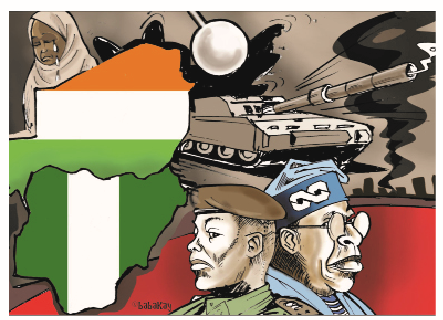
In his seminal work “Why Nations go to War,” the eminent political analyst and author John G. Stoessinger delves into the crucial influence that political and military leaders wield in driving their countries into conflicts. Stoessinger underscores that the pivotal decisions to engage in warfare lie in the hands of these leaders—whether they hold political or military positions.....KINDLY READ THE FULL STORY HERE▶
Traditionally, the responsibility for the nation’s inclination towards war or peace rests squarely on the shoulders of leaders. As such, Stoessinger urges leaders to exercise utmost caution before initiating war, recognizing that impulsive decisions can needlessly plunge nations into catastrophic turmoil….CONTINUE READING
Stoessinger’s assessment of the theory and practice of warfare also centers on the benefits a nation stands to gain from entering a war. Analyzing the perpetual Arab-Israeli conflicts in the Middle East, Stoessinger characterizes the decisions made by leaders from both sides as a zero-sum game. In this perspective, leaders manipulate this concept to render war appealing and entangle their nations in often unnecessary conflicts.
Inevitably, the actual course of war seldom adheres to initial plans, often failing to yield the desired political or economic outcomes. Stoessinger likens war to a sealed keg of gunpowder, cautioning against opening it unless absolutely necessary, as doing so would result in spillage affecting everyone involved.
Stoessinger firmly asserts that there are no victors in war, as all parties involved ultimately tally their losses, regardless of their scale. The aftermath of war sees all participants on the losing side.
Examining the current potential for conflict between Nigeria, leading the ECOWAS forces, and Niger Republic, Stoessinger labels it a zero-sum game due to the reciprocal nature of gains and losses.
He highlights that any advantages secured by Nigeria would be offset by the setbacks endured by Niger Republic, and vice versa.
Stoessinger draws attention to the intrinsic fraternal bond between these two neighboring African regions, united by blood, marriage, religion, tradition, trade, and ethnicity. An assault on Niger Republic, he contends, could easily be construed as an attack on northern Nigeria.
This understanding elucidates the ongoing diplomatic efforts by prominent northern figures in Nigeria, including traditional leaders, Islamic clerics, elders, and politicians. Their mission is to avert any potential attacks on Niger Republic by Nigeria and its allies in ECOWAS, with Western powers exerting influence behind the scenes, poised for intervention.
Indeed, Stoessinger prompts us to recall France’s support for Biafra—an unsuccessful secessionist movement—in the Nigerian Civil War (1967-1970). This historical context underscores the complex geopolitical dynamics at play in such conflicts.


