
Latest
Full List Sparks Outrage — David Mark, Lamido Among June 12 Annulment Signatories

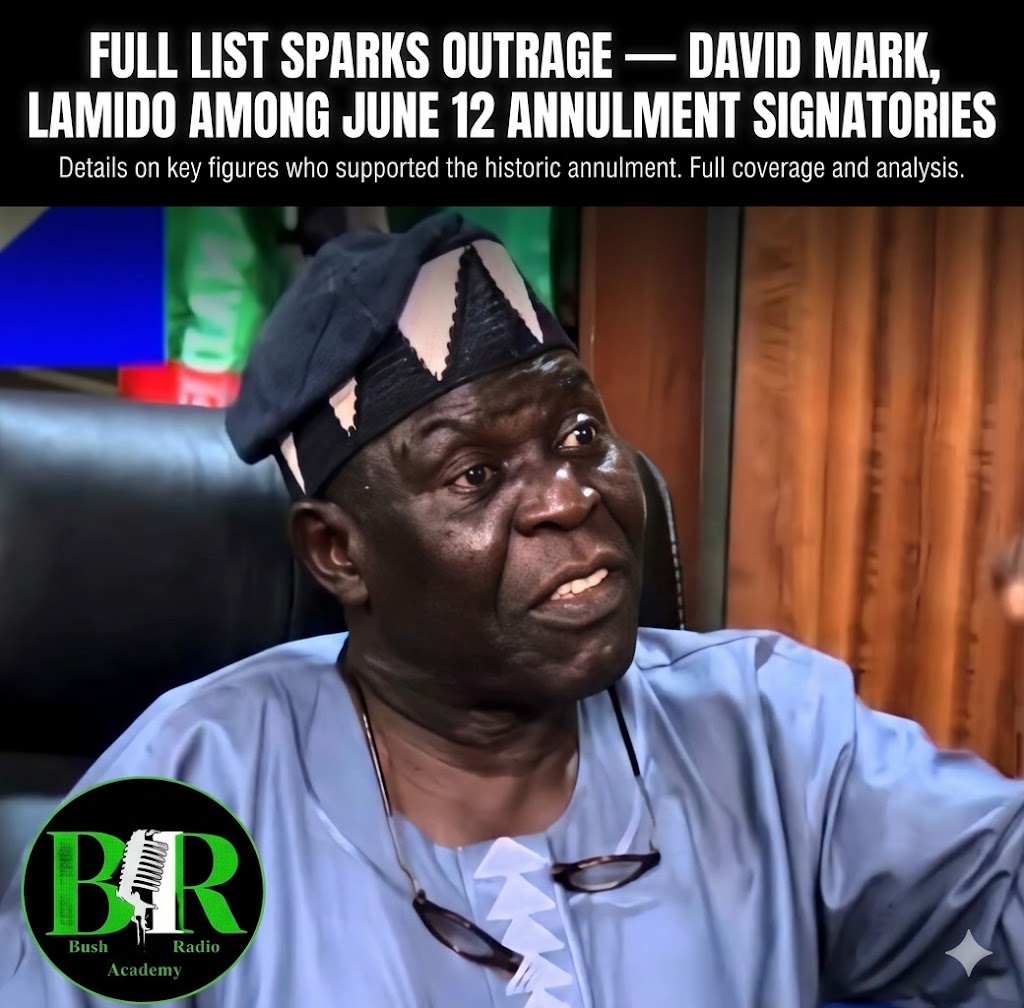
The General Secretary of the National Democratic Coalition (NADECO), Ayo Opadokun, has identified several prominent political, military, and technocratic figures he claimed endorsed the process that led to the annulment of the June 12, 1993 presidential election won by Chief MKO Abiola.
The allegation is contained in Opadokun’s newly released 509-page book, The NADECO Story, which was unveiled last week in Lagos.
In Chapter 27 of the book, Opadokun accused key figures within Nigeria’s political establishment of supporting the Interim National Government arrangement that emerged after the military regime of Gen. Ibrahim Babangida annulled the June 12 election.
Among those listed as signatories to the controversial document were former Chief of General Staff, Augustus Aikhomu; former Interim National Government Head, Ernest Shonekan; former Senate President, David Mark; former Foreign Affairs Minister, Tom Ikimi; former Anambra State Governor, Jim Nwobodo; and former Chief of Staff, Supreme Headquarters, Musa Yar’Adua.
Others named include former Social Democratic Party (SDP) Chairman, Tony Anenih; Adamu Ciroma; former Jigawa State Governor, Sule Lamido; Gen. Aliyu Gusau; Patrick Dele-Cole; Dapo Sarumi; Abubakar Rimi; Olusola Saraki; and Joe Nwodo.
Opadokun wrote, “The big Nigerian ‘Patriots,’ who also signed the remarkable document that nailed the coffin of June 12, include people of note, who for whatever reason sold their integrity and dignity to subsume the popular mandate of MKO.”
According to the book, the agreement followed the establishment of a tripartite committee made up of representatives of the military government, the SDP, and the National Republican Convention (NRC).
The committee reportedly agreed to set up an Interim National Government headed by Shonekan as the June 12 political crisis intensified.
“The Guardian recalls that in 1993, as the June 12 election crisis degenerated with no end in sight, a tripartite committee comprising members of the then military regime and the two political parties, SDP and NRC, buckled under the weight of pressure. They compromised and then agreed to form an Interim National Government,” the book stated.
Opadokun identified Aikhomu as the first signatory to the document, noting that Shonekan signed second, while Abdulrahman Okene signed as the third participant in the arrangement.
The author also criticised some SDP leaders, including Tony Anenih, who headed the party that won the June 12 election.
“Chief Tony Anenih was chairman of SDP at the time of the June 12 annulment. It was the victory of the party he led that was negotiated away,” the book stated.
On Joe Nwodo, Opadokun noted that he was the only political figure who signed the document “with reservations,” although no further explanation was reportedly provided.
The book further named individuals Opadokun accused of legitimising military rule and aiding the annulment, describing them as belonging to a “Hall of Shame.”
He accused former Katsina State Governor, Saidu Barda, of threatening violence on behalf of NRC governors over any move to revisit June 12.
According to Opadokun, “NRC Governor Saidu Barda of Katsina State, on behalf of the 14 NRC governors, declared that any attempt to revisit June 12 would result in ‘chaos and bloodshed on an unprecedented scale.’”
The author also alleged that former senator Jonathan Zwingina, who served as Director-General of Abiola’s campaign organisation, collaborated with forces that undermined the June 12 mandate.
The book additionally blamed the late Senator Arthur Nzeribe and his Association for Better Nigeria for obtaining a legal order that halted the announcement of the election results.
“Nzeribe secured an extra-judicial ex parte order halting further announcement of the election results. General Babangida, in a national broadcast, cancelled the entire election and dissolved the electoral body, NEC,” Opadokun wrote.
Former Attorney-General and Minister of Justice, Chief Clement Akpamgbo, SAN, was also accused of drafting decrees that allegedly legitimised the transition arrangements and protected military interests.
According to Opadokun, Akpamgbo “crafted various anti-democratic decrees to fit all dubious steps taken by General Babangida to sabotage his own transition agenda.”
The author further claimed that Akpamgbo warned Nigerians under the Interim National Government that “any further mention of June 12 was an act of high treason.”
Opadokun also revisited the emergence of Gen. Sani Abacha as Head of State after the collapse of the Interim National Government in November 1993.
He alleged that Abacha “capitalised on the provisions of Section 5 Sub-Section 48 of the ING Decree 61 of 1993” to assume power from Shonekan.
The book referenced the later admission by former National Electoral Commission Chairman, Humphrey Nwosu, that Abiola won the election with 8,323,305 votes against Bashir Tofa’s 6,073,917 votes.
“Consequently, Alhaji M.K.O. Abiola won the election, but NEC could not announce the result of the election because of the Abuja High Court order,” Nwosu was quoted as saying.
Opadokun maintained that June 12 remains “the freest, fairest and most peaceful and credible election in Nigeria’s history.”
He also defended NADECO’s legacy, insisting that the June 12 struggle was not exclusively a Yoruba cause but “a rainbow coalition of Nigerians from North, South, East and West.”
According to him, 52 eminent Nigerians signed the communiqué establishing NADECO as the umbrella body for the pro-democracy movement against military rule.
“It was signed by 52 eminent Nigerians from across the country’s basic divides, be it politics, ethnicity, religion, sex and even age,” he wrote.


UK Makes Major Visa Change, Allows Slavery Victims To Escape Abusive Employers

Drama On Set Clemson Cornell Reveals Why Liz Benson Ran Away

Full List: Remaining Public Holidays In Nigeria For 2026

Emir Of Gumel, Ahmed Sani II, D!es In Egypt

Dalung Demands DSS Probe Over Senator Buba’s Alleged Bandit Link

WHY OKPEBHOLO KNOWS WHAT HE IS SAYING ABOUT TINUBU’S 2.5 MILLION VOTES

Fake Agency Scandal: ICPC Recommends Punishment for 13 Officials — See Full List

Cement Hits ₦15,000: FCCPC Demands Answers From Dangote, BUA, Other Producers

Was The Sacrifice Worth It?” – El-Rufai’s Son Reveals What Father Told Him In Detention
