
Latest
Fresh Blow For NDC As Court Dismisses Suit Challenging Electoral Act

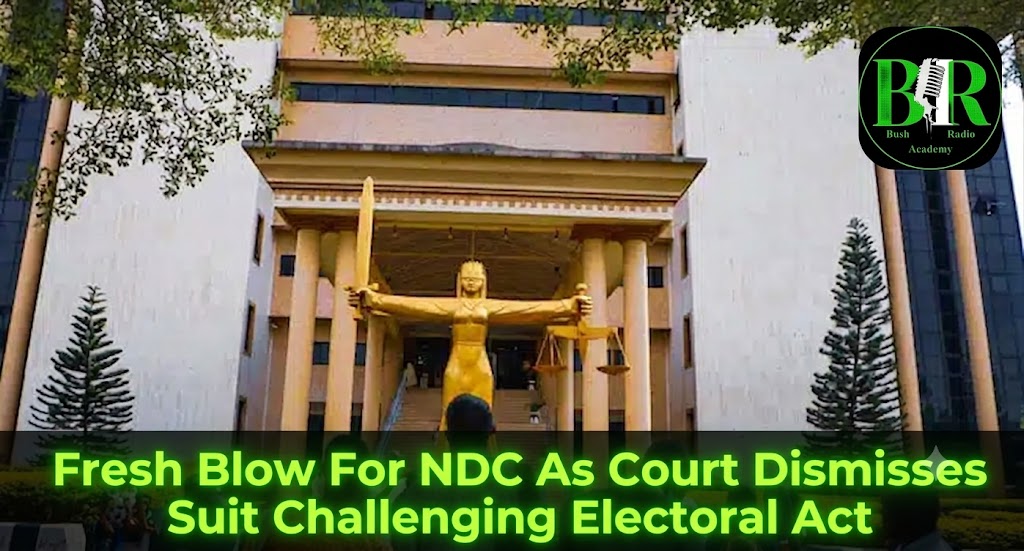
The Federal High Court in Abuja has dismissed a suit filed by the National Democratic Congress (NDC) challenging provisions of the Electoral Act 2026 relating to the qualification and disqualification of candidates for elective offices.
Delivering judgment on Tuesday, Justice Muhammed Umar held that the case lacked merit, ruling that the disputed sections of the Electoral Act are consistent with and complementary to the provisions of the 1999 Constitution.
The NDC had instituted the suit against the Attorney General of the Federation, the Clerk of the National Assembly, Senate President Godswill Akpabio and the Independent National Electoral Commission (INEC).
The party sought a declaration that Sections 138 and 77(5) of the Electoral Act 2026 were unconstitutional and further asked the court to hold that disputes over the qualification or disqualification of candidates could still be entertained after an election.
However, Justice Umar upheld the preliminary objections raised by the defendants and dismissed the suit.
According to the judge, the action primarily sought the court’s interpretation of the Electoral Act alongside relevant constitutional provisions.
“The plaintiff is invoking the interpretative jurisdiction of this honourable court in respect of the provisions of the Electoral Act 2026 on the one hand and the 1999 Constitution on the other hand,” the judge stated.
Justice Umar also rejected the NDC’s argument that the matter qualified as a pre-election case merely because INEC’s election timetable was attached to the originating summons.
“The fact that the defendant’s timetable is attached cannot make the case within the contemplation of Section 285… there is no deposition… that raises questions as to the timetable,” he held.
The court also upheld the preliminary objection filed by the Clerk of the National Assembly, ruling that the NDC failed to comply with the legal requirement of serving a pre-action notice before commencing the suit.
Justice Umar consequently struck out the case against the Clerk, describing the omission as a fatal procedural defect.
“The non-service of the pre-action notice makes this suit incompetent against the second defendant,” he ruled.
On the substantive issues, the court held that Section 138 of the Electoral Act does not conflict with the Constitution but instead provides the legal procedure and timeline for challenging the qualification of candidates emerging from party primaries.
Justice Umar ruled that anyone seeking to challenge the eligibility of a candidate must do so during the pre-election period rather than after the conduct of an election.
“Any aggrieved party who intends to challenge any candidate that emerged at the primary election of a political party on grounds of disqualification… must do so at the pre-election level,” he said.
The judge further declared that the contested provision strengthens, rather than contradicts, the constitutional framework governing elections.
“The provision of Section 138 of the Electoral Act 2026 complements the provision of the Constitution, but is not in conflict with it. The contention of the plaintiff that Section 138 is inconsistent with the Constitution is of no merit,” he ruled.
Justice Umar also declined the request to invalidate Section 77(5) of the Electoral Act, noting that the issue had already been determined by the Court of Appeal and remained binding on the Federal High Court under the doctrine of judicial precedent.
He stressed that lower courts are bound to follow decisions of higher courts, thereby affirming the validity of the challenged provisions.
The judgment effectively reinforces the legal position that disputes arising from party primaries concerning the qualification or disqualification of candidates must be resolved before elections are conducted.


Coaching Shake-Up: Bubista Departs Cape Verde, Ivory Coast Reappoint Renard

State Police Bill Sparks Row As ADC Says ‘WhatsApp Votes Are Illegal

Police Summon VeryDarkMan Over Allegations Against AIG Moshood Jimoh

People Got It Wrong’ — Wike Reveals What His Dispute With Fubara Is Really About

Kidnapping: FG Issues Fresh Directive To Expel Students Found Involved

Fear Grips Kidnappers, Bandits as Okpebholo Deploys 497 Forest Guards Across Edo

Aliko Dangote’s Daughter Reveals Sh*cking Condition In Billionaire’s Will

Aisha Yesufu Unleashes Scathing Reaction To Peter Obi’s Channels TV Interview

This Is Why He Was Arrested’ — Osun Speaker Breaks Silence On SSG Saga
