
Ganduje Sparks Political Controversy, Labels PDP A Defunct Party
 Follow us on Google News
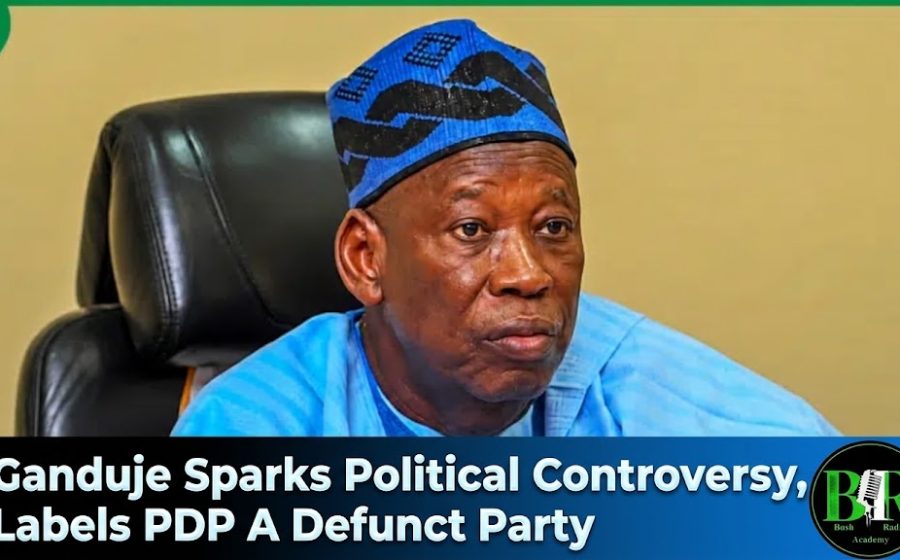
Former National Chairman of the All Progressives Congress (APC), Abdullahi Ganduje, has described the Peoples Democratic Party (PDP) as a “defunct” political party while calling on Nigerians to strengthen their belief in the country and its future.
According to Bush Radio Academy, Ganduje made the remarks on Wednesday in Abuja during the annual conference of the Forum of Former Deputy Governors of Nigeria.
The former Kano State governor made the comment while acknowledging former Delta State governor Ifeanyi Okowa, who served as the PDP’s vice-presidential candidate in the 2023 presidential election.
Referring to Okowa, Ganduje described him as a former governor and vice-presidential candidate of the “defunct” PDP, a remark that drew attention to the party’s current political standing.
Speaking on nation-building, Ganduje urged Nigerians to develop a stronger sense of patriotism and confidence in the country. He expressed concern that Nigeria’s cultural and ethnic diversity, which should be a source of strength, was increasingly being treated as a liability.
He questioned whether Nigerians genuinely believed in the country and its potential, stressing the need to recognise diversity as an asset capable of promoting national development rather than division.
Ganduje also argued that British colonial authorities brought Nigeria’s diverse communities together primarily to advance their economic interests. According to him, the amalgamation of the different groups was largely intended to secure raw materials for British industries rather than to build a united and stronger nation.
Despite his criticism of the colonial legacy, the former APC chairman praised Nigeria’s First Republic politicians for their nationalist spirit, which he said contributed to the formation of political parties and the eventual attainment of independence.
He commended the country’s founding political leaders for pursuing independence without resorting to armed struggle, contrasting Nigeria’s experience with that of other countries that fought wars to free themselves from colonial rule.
Ganduje’s remarks highlighted the continuing debate over Nigeria’s political landscape, national identity and the challenges of building unity among its diverse ethnic and cultural groups.




Comments
0 comments