
KWARA IS NOT RIVERS—BUT INJUSTICE HAS NO STATE OF ORIGIN
 Follow us on Google News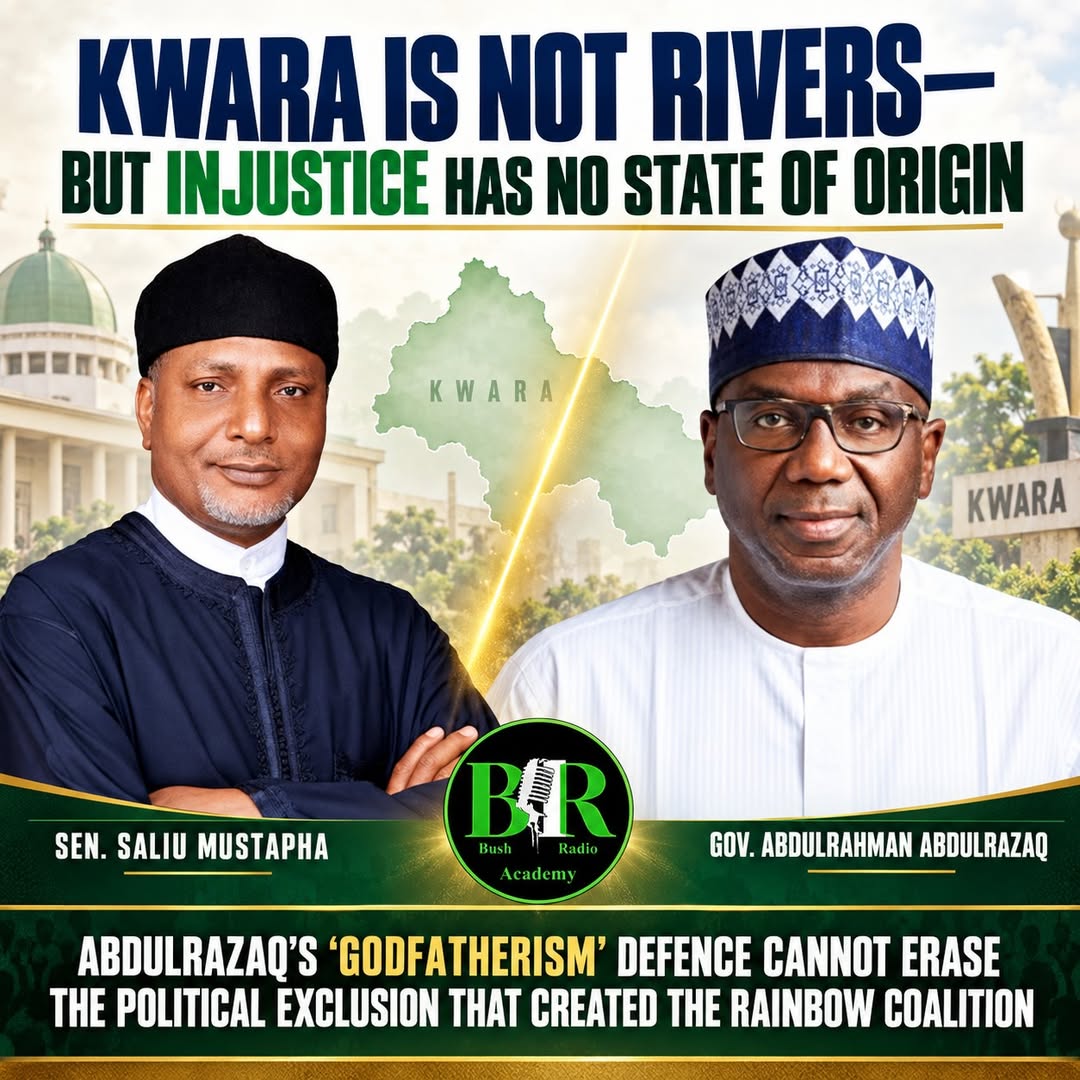
KWARA IS NOT RIVERS—BUT INJUSTICE HAS NO STATE OF ORIGIN
ABDULRAZAQ’S “GODFATHERISM” DEFENCE CANNOT ERASE THE POLITICAL EXCLUSION THAT CREATED THE RAINBOW COALITION
By Osigwe Omo-Ikirodah
Governor AbdulRahman AbdulRazaq’s latest defence is politically clever, but it avoids the central question.
Nobody has said Kwara is a local government in Rivers State. Nobody has asked Nyesom Wike to determine the political destiny of Kwarans.
The real question is this:
Why did so many powerful forces that built, defended and sustained the Kwara APC suddenly find themselves without political space inside the same party?
That is the question the accusation of “Rivers-style godfatherism” is designed to bury.
What Wike actually accused the governor of
Wike’s charge was specific: Governor AbdulRazaq had politically displaced the state’s three serving senators and several members of the House of Representatives, leaving influential APC stakeholders without tickets or meaningful accommodation.
His warning was blunt:
“You removed three senators; you removed members of the House of Representatives. You must be a super governor to survive that.”
That accusation cannot be answered merely by saying, “the party took the decisions.”
Political parties formally conduct primaries and submit candidates, but parties do not act in a vacuum. Political leadership must accept responsibility for the pattern and consequences of candidate selection—especially where one political tendency appears to emerge with virtually everything while other major stakeholders complain of exclusion.
The dispute was also much wider than Senator Saliu Mustapha.
All three serving senators—Mustapha, Oyelola Ashiru and Sadiq Umar—called for urgent reconciliation and complained about the exclusion of legitimate stakeholders from key decisions.
The G15 brought together aggrieved governorship aspirants, senators, representatives, party elders and members of The O’To Ge Progressives. Several serving representatives also rejected the outcomes of the House of Representatives primaries.
This was not the tantrum of one disappointed aspirant. It was a statewide breakdown involving several centres of political influence.
The injustice against Saliu Mustapha
Senator Saliu Mustapha’s treatment deserves to be stated plainly.
Mustapha’s camp maintains that he prepared and consulted for the governorship contest—not for a return to the Senate. Yet, as the National Assembly process unfolded, his name was reportedly associated with a senatorial primary he said he had not entered.
The governorship ticket ultimately went to Speaker Yakubu Danladi-Salihu amid protests from multiple aspirants.
Then the Kwara Central senatorial route was closed to Mustapha when Governor AbdulRazaq became the APC’s preferred candidate and the only reported purchaser of the party’s forms for that seat.
Mustapha therefore entered the political season as a serving APC senator and major governorship contender but emerged without either APC ticket. The sitting governor then positioned himself for Mustapha’s Kwara Central seat.
Calling Mustapha “defeated and bitter” or dismissing his reaction as sour grapes does not explain that sequence.
His case is that he was denied a fair governorship opportunity, denied a genuine route back to the Senate and confronted by an arrangement calculated to erase his political relevance.
If Mustapha is a paperweight, why the panic?
The governor’s allies cannot call Mustapha a political paperweight in one breath and then describe his new alliance as a threat capable of confusing voters and reducing President Tinubu’s votes in the next.
A man whose movement supposedly has no consequence cannot simultaneously be presented as a danger to the APC’s presidential calculations.
Mustapha is a serving senator, a longstanding progressive politician and one of the recognised actors in the coalition that powered the 2019 O’To Ge revolt.
O’To Ge was never the private inheritance of one beneficiary. It was a mass coalition of politicians, community networks, activists and voters united by a determination to end political exclusion and imposed control.
AbdulRazaq became governor on the strength of that collective uprising; he did not manufacture it alone.
If some of the forces that helped create O’To Ge now believe its promises of inclusion, fairness and collective leadership have been betrayed, they have every democratic right to reorganise.
A beneficiary of a coalition cannot criminalise coalition-building simply because that coalition is no longer arranged around him.
Wike did not create the Kwara crisis
The accusation of imported godfatherism reverses cause and effect.
Wike did not conduct the Kwara APC primaries. He did not decide who would receive or be denied APC tickets. He did not form the G15 or manufacture the grievances of the governorship aspirants and federal lawmakers.
The crisis existed inside Kwara APC before the Rainbow Coalition offered the aggrieved politicians another platform.
Accommodation is not the same as creation.
When a governing party shuts influential members out, it cannot dictate where they must go next. It also cannot demand that an opposition party leave its ballot lines empty so that the governor’s preferred candidates face no serious contest.
Kwara is not a Rivers local government—but neither is Kwara the private political estate of any governor.
The Rainbow Coalition could protect Tinubu’s votes
The excluded Kwara political blocs had alternatives.
They could have joined the ADC or another opposition coalition explicitly organised to defeat President Bola Ahmed Tinubu. They could have carried their structures, grievances and supporters into a hostile platform and converted an internal APC wound into votes against the President.
Instead, they entered a PDP-based Rainbow arrangement whose leading actors have publicly pledged support for Tinubu’s re-election.
For accuracy, the national PDP has not formally endorsed Tinubu. It is the Wike-aligned Rainbow platform, together with Mustapha and his Kwara allies, that has declared support for the President while contesting legislative and local elections against the governor’s camp.
That may be unconventional, but Nigerian coalition politics has never been confined neatly within party colours.
In 2023, Tinubu won Rivers State with 231,591 votes, defeating both Peter Obi and the PDP presidential candidate in a state then governed by the PDP. Wike has repeatedly claimed responsibility for mobilising the political structure that delivered that victory.
Whatever anyone thinks of Wike personally, Rivers demonstrated the electoral value of cross-party cooperation.
Who currently possesses a comparable cross-party structure capable of organising Rivers decisively for Tinubu in 2027?
Presidential elections are won with votes—not certificates of ideological purity.
Had Mustapha, the G15, The O’To Ge Progressives and the elders’ caucus moved into an anti-Tinubu coalition, their critics would have accused them of betraying the President.
Instead, they chose an arrangement that allows them to oppose AbdulRazaq’s local political order while retaining their support for Tinubu nationally.
That may preserve votes the Kwara APC crisis was in danger of losing.
The same-day ballot argument
The governor’s aide argues that voters may become confused if asked to support Tinubu under the APC while voting for PDP National Assembly candidates on the same day.
But Nigerian voters can split their ballots. Each office appears on a separate ballot, and political organisations are capable of educating their supporters about their preferred choices.
If the genuine concern is confusion, the response should be voter education and reconciliation—not an attempt to deny political opponents an alternative platform.
The argument also exposes a contradiction.
The governor’s camp says the Rainbow forces are inconsequential, yet fears their capacity to influence presidential votes. It says the party processes were fair, yet wants those aggrieved by the outcomes denied another platform.
The question AbdulRazaq must answer
The phrase “Rivers-style godfatherism” changes the subject from exclusion in Ilorin to Wike’s reputation in Port Harcourt.
But Wike’s political history cannot absolve Governor AbdulRazaq of responsibility for the crisis within his political family.
Saliu Mustapha changed platforms after the platform on which he served shut the doors to his governorship aspiration and his return to the Senate. He has nevertheless repeatedly endorsed President Tinubu’s re-election.
He also did not move alone. His departure forms part of a broader revolt by politicians who believe the collective O’To Ge victory is being converted into a narrow succession project.
The decisive question is therefore not whether Wike comes from Rivers.
It is whether justice, inclusion and internal democracy were respected in Kwara.
Calling Wike a godfather will not erase the excluded senators, displaced representatives or aggrieved governorship aspirants.
Neither will it erase the political irony that a movement born to resist imposition is now being revived by some of its founders against a government it once helped install.
Kwara is not Rivers. But neither is Kwara the private inheritance of one political tendency.
When a house drives out its strongest occupants, it cannot accuse the neighbour who offers them shelter of starting the fire.
Osigwe Omo-Ikirodah is the Principal and CEO of Bush Radio Academy.






Comments
0 comments