Connect with us

Latest

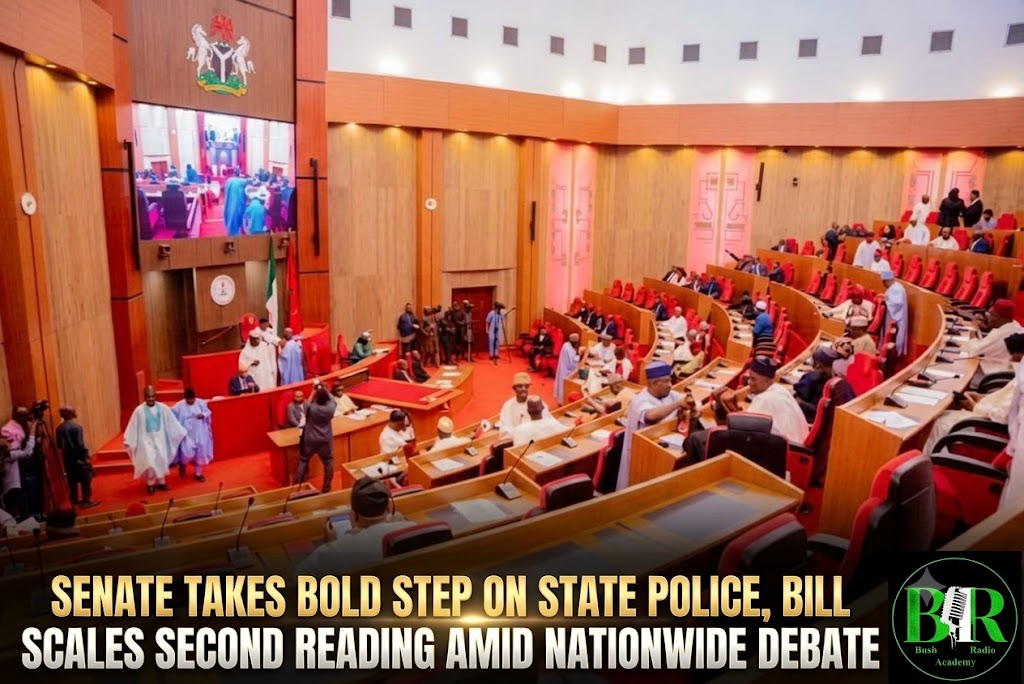
Senate Takes Bold Step On State Police, Bill Scales Second Reading Amid Nationwide Debate

Published

on

A bill proposing the creation of state police and the transfer of certain policing responsibilities to subnational governments has successfully passed its second reading in the Senate.....KINDLY READ THE FULL STORY HERE▶

The legislation is designed to strengthen Nigeria’s internal security system in response to rising nationwide security concerns.

The proposed law, titled A Bill for an Act to Alter the Constitution of the Federal Republic of Nigeria, 1999 to Provide for the Establishment of State Police and for Related Matters (Sixth Alteration), 2026 (SB. 794), was sponsored by Senate Leader Opeyemi Bamidele.

Lawmakers across party lines supported the bill during its presentation on the floor of the Senate.

Following debate, Senate President Godswill Akpabio referred the bill to the Senate Ad-hoc Committee on the Review of the 1999 Constitution for further examination and reporting. The committee is chaired by Deputy Senate President Jibrin Barau.

While presenting the general principles of the bill, Bamidele said the initiative was necessary due to the escalating security challenges facing the country, including terrorism, banditry, kidnappings, herder-farmer clashes, cultism, armed robbery, pipeline vandalism, and cybercrime.

He argued that the existing centralised policing structure has struggled to effectively address these complex and locally driven security threats, noting that many Nigerians have consistently called for a decentralised policing system.

The bill proposes shifting policing powers from the Exclusive Legislative List to the Concurrent Legislative List in order to promote cooperative federalism in security management. It also provides for the establishment of both federal and state police institutions, along with State Police Service Commissions to oversee operations.

Bamidele stressed that the reform is not intended to weaken national unity but to enhance governance by allowing different levels of government to respond more effectively to security challenges within their jurisdictions.

He acknowledged concerns about possible misuse of state police by state authorities but said the bill includes safeguards such as federal oversight mechanisms, standardised national policing guidelines, legislative confirmation of senior appointments, and regular performance reviews.

The proposal also allows for federal intervention in situations where there is a total breakdown of law and order to maintain balance and accountability.

According to Bamidele, decentralised policing would improve intelligence gathering, ensure quicker responses to security threats, and strengthen trust between communities and law enforcement agencies.

He added that it would also reduce the burden on the Federal Police, enabling them to focus on interstate crimes, terrorism, organised criminal networks, cybercrime, border security, and protection of federal assets.

He further noted that countries such as the United States, Canada, Australia, and Germany operate similar multi-tier policing systems, arguing that Nigeria, as a federal state, should adopt a comparable structure.

Several senators, particularly from the northern region, supported the bill, describing it as a potential long-term solution to Nigeria’s security challenges.

Senate Chief Whip Tahir Monguno also backed the proposal, stating that it would help regulate the proliferation of vigilante groups and provide a more structured and accountable security framework.

The bill has now been referred to the relevant committee for further legislative review.

Advertisement
Click to comment

Leave a Reply

Your email address will not be published. Required fields are marked *