
Viral Video Shows Hair-Raising Encounter As Lightning Hits Airplane Mid-Journey
 Follow us on Google News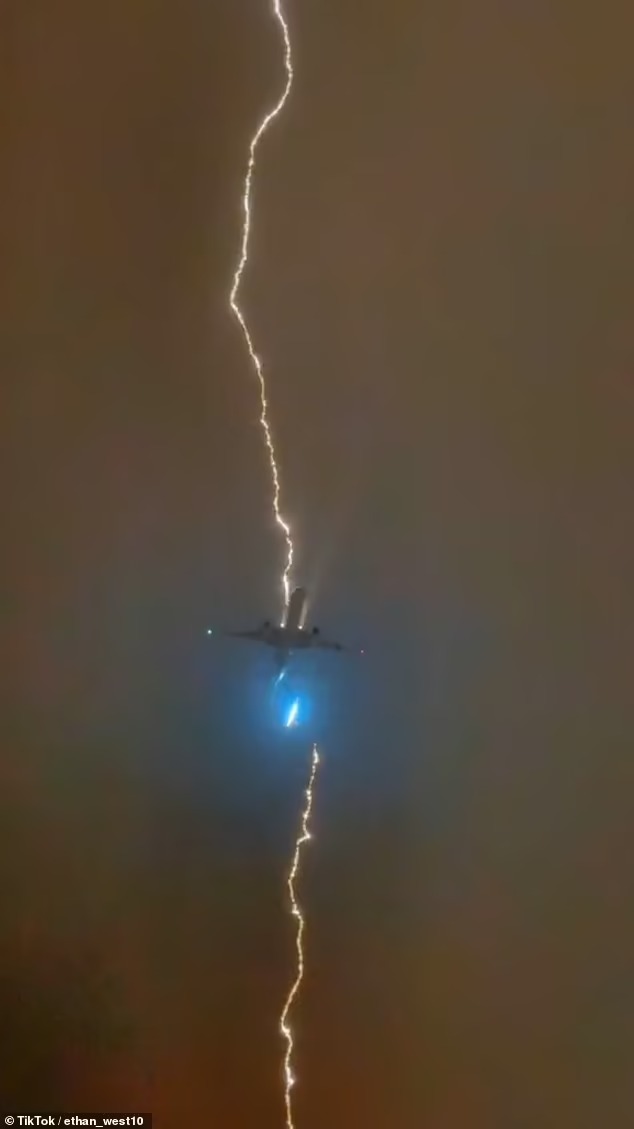
Viral Video Shows Hair-Raising Encounter As Lightning Hits Airplane Mid-Journey
An online sensation ensued as a video circulated, capturing the intense moment a plane en route from Vancouver to London, carrying 400 passengers, encountered a lightning strike mid-flight………CONTINUE READING
Dailymail reported on Thursday that the Air Canada Boeing 777 experienced the lightning strike shortly after departing from Vancouver Airport in Canada. Remarkably, despite the high-stakes incident, the aircraft safely completed its journey, landing at London Heathrow according to the predetermined schedule.
The viral footage, recorded by aviation enthusiast Ethan West, who harbors aspirations of becoming a pilot, showcased the lightning bolt directly striking the plane as it descended toward the ground, without disrupting the flight’s course.
While the visual might have been alarming for onlookers, passengers on board likely remained oblivious to any effects of the lightning strike. This is due to the advanced features of modern aircraft, including materials such as carbon composites coated with a thin layer of copper, specifically designed to conduct electricity around the aircraft, ensuring the safety of occupants.
Despite the potential for passengers to witness a lightning flash or hear thunder following a strike, the safety measures in place mean they are not in immediate danger or at risk of being directly affected.
Upon reaching London Heathrow, Air Canada confirmed that the aircraft underwent a thorough inspection to guarantee the safety of the entire flight.
According to the National Weather Service, lightning strikes on planes occur approximately once or twice a year on average. Commercial passenger planes, cruising at speeds around 500 mph, face lightning bolts moving at an astonishing 700 million mph.
Most lightning strikes on aircraft occur between March and July, particularly when planes traverse clouds during ascent or descent. These strikes are more common in near-freezing temperatures at high altitudes or turbulent conditions, with the frequency influenced by geographical location.
With temperatures soaring to nearly 30,000°C, lightning is exceptionally hot—three times hotter than the sun’s surface. While lightning-related incidents are rare, history records nine plane crashes attributed to lightning, mainly involving commercial airliners and two military planes. Among these incidents, the most devastating was the 1971 LANSA Flight 508, resulting in the tragic loss of 91 out of 92 passengers and crew members.
For more information join our WhatsApp group by clicking the link here: WhatsApp Group Invite
For inquiries only, contact us at omoikirodahoshiobugie@gmail.com, 08075806790 (WhatsApp only). For paid articles covering content related to shows, music promotion, asylum letters, concerts, politics, advertisement hit up the Whatsapp number 08075806790.
Source: Bushradiogist





Comments
0 comments