
Latest
President Tinubu Bets Big On Tax Reforms To Reboot Nigerian Economy

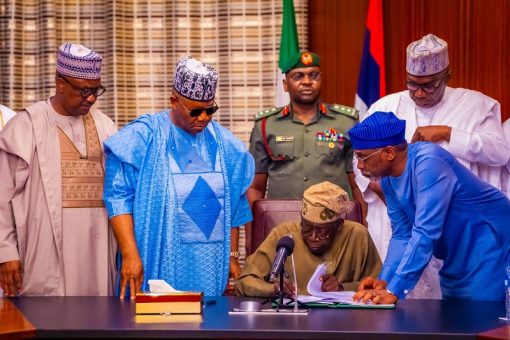
President Bola Ahmed Tinubu’s signing of four tax bills yesterday marked the beginning of a new chapter in Nigeria’s tax administration.....KINDLY READ THE FULL STORY HERE▶
A set of newly signed tax laws, scheduled to take effect in January 2026, represent a significant milestone in Nigeria’s economic transformation, according to President Bola Tinubu. The reforms streamline the previously fragmented and uncoordinated tax system, laying the groundwork for a more efficient and equitable fiscal structure.
Speaking at the signing ceremony at the State House in Abuja, President Tinubu described the laws as a “gateway to a new economy and fresh business opportunities.”
“This is a clear message to the world: Nigeria is ready and open for business. We are undergoing a transition—we’ve revised policies and addressed past concerns,” he stated.
Calling the event a “turning point” in Nigeria’s economic journey, the President emphasized the reforms as essential for modernization. “What we’ve done today is charting a new path for our nation. Leadership must clear the way for progress, especially during uncertain times—and that’s what we’re doing here,” he said.
The legislative package includes:
-
Nigeria Tax Reform Act
-
Nigeria Tax Administration Act
-
Nigeria Revenue Service (Establishment) Act
-
Joint Revenue Board (Establishment) Act
These laws form the cornerstone of the administration’s broad fiscal policy overhaul, developed through 10 months of stakeholder engagement and legislative scrutiny.
President Tinubu commended the National Assembly for their “courage and sense of duty,” acknowledging the challenges faced during the reform process. “Nation-building is never easy—just like construction, it requires strong foundations and binding agents,” he added.
The new framework is designed to bring relief, foster fairness, stimulate growth, unify tax processes, eliminate redundancies, and enhance investor confidence. Tinubu stressed that the reforms would ease burdens on working families, small businesses, and low-income earners while improving transparency and efficiency.
On his verified X handle (@officialABAT), the President highlighted that the laws pave the way for a “leaner, fairer” Nigeria focused on creating opportunities.
“These are not just tax code revisions. They are the first pro-people tax cuts in a generation—offering real relief to those who need it most,” he wrote. “Our tax system has long been convoluted, unfair, and stifling. That era ends now.”
He pledged a new regime that is fair, transparent, and supportive of innovation, productivity, and social equity.
National Assembly Leaders Praise Historic Reform
Senate President Godswill Akpabio hailed the development as historic. He noted the overhaul of outdated laws like the 1901 Stamp Duties Act, last updated in 1939.
“You have harmonised Nigeria’s tax system. By signing these bills, you are changing the nation’s future. Generations to come will remember this,” Akpabio said.
Recalling the dire fiscal situation inherited in 2023, he said: “Nigeria was on life support, with revenue consumed by debt servicing and subsidies. You came in and rescued the country.”
Senator Sani Musa, Chairman of the Senate Committee on Finance, emphasized that the reforms reflect the “true aspirations of Nigerians,” following nationwide consultations—even with groups initially opposed, especially in the North.
House Committee on Finance Chairman James Faleke described the effort as a “once impossible mission” that succeeded due to nationwide collaboration.
Implementation Set for January 2026
Dr. Zacch Adedeji, Chairman of the newly established Nigeria Revenue Service (formerly FIRS), said the laws will come into force on January 1, 2026. This timeline aligns with the fiscal calendar and allows adequate public awareness and preparation.
“A mid-year rollout would disrupt fiscal coherence. The six-month window ensures a smooth transition and follows global best practices,” he explained.
Pro-Poor, Transparent Reforms
Taiwo Oyedele, Chairman of the Presidential Fiscal Policy and Tax Reforms Committee, described the reforms as “pro-poor.” He reassured citizens that low-income earners, micro-businesses, and vulnerable populations would benefit.
“Over one-third of Nigerian workers will be exempt from PAYE, and more than 90% of micro, small, and nano enterprises are now free from corporate tax, VAT, and withholding tax,” he said.
Additionally, he noted that food, education, healthcare, housing, transport, and accommodation are now completely VAT-exempt, offering much-needed relief to Nigerian households.
Oyedele added that the reforms introduce unprecedented transparency measures. “For the first time, tax transparency is legally tied to how public funds are used,” he stated.
Breakdown of the Four New Laws:
-
Nigeria Tax Reform Act (Ease of Doing Business): Consolidates fragmented tax statutes into a modern code, improving investor predictability and reducing compliance burdens.
-
Tax Administration Act: Establishes a unified tax framework across all government levels, eliminating duplicative processes and streamlining operations.
-
Nigeria Revenue Service (Establishment) Act: Replaces the FIRS with an autonomous, performance-driven agency responsible for collecting both tax and non-tax revenues.
-
Joint Revenue Board (Establishment) Act: Creates a formal structure for coordination between federal, state, and local tax authorities. It also introduces a Tax Appeal Tribunal and an Office of the Tax Ombudsman to manage disputes and complaints.
Support from State and Private Sector Leaders
Present at the ceremony were top government officials, including the Chairman of the Nigeria Governors’ Forum, Kwara State Governor Abdulrahman Abdulrazaq; Chairman of the Progressive Governors Forum, Imo State Governor Hope Uzodinma; Minister of Finance Wale Edun; and Attorney-General Lateef Fagbemi (SAN).
The Nigeria Employers’ Consultative Association (NECA) welcomed the laws, with Director-General Adewale Smatt-Oyerinde stating they would stimulate growth and open up the economy. He noted that the Organised Private Sector had long grappled with the burden of excessive taxes and levies, and expressed hope that the new laws mark the beginning of sustained economic transformation.



Breaking: Complete List Of Charges Filed Against Timipre Sylva And Alleged Coup Network Exposed

“TensioIn Abuja: INEC Leadership, Mackenzie Anyanwu In Fresh Legal Battle Over Court Order

Exit Sparks Reaction: Wale Edun Says He Is Proud Of His Time In Office

Inside Tinubu’s Mind: How Bola Ahmed Tinubu Responds To Critics Revealed

Supreme Court Showdown Looms As Julius Abure Fights For Control of Labour Party

Breaking: Federal Government Of Nigeria Bans Cement Importation, Releases Full List Of Restricted Goods

Supreme Court Shocks Kano Emirate Case, Adjourns Hearing Till 2027

Here’s What Happened” — Ex-Army Chief Buratai Speaks On Borno Airstrike Tragedy

Succession Buzz: Olusi Reveals Who May Replace Sanwo-Olu In 2027
