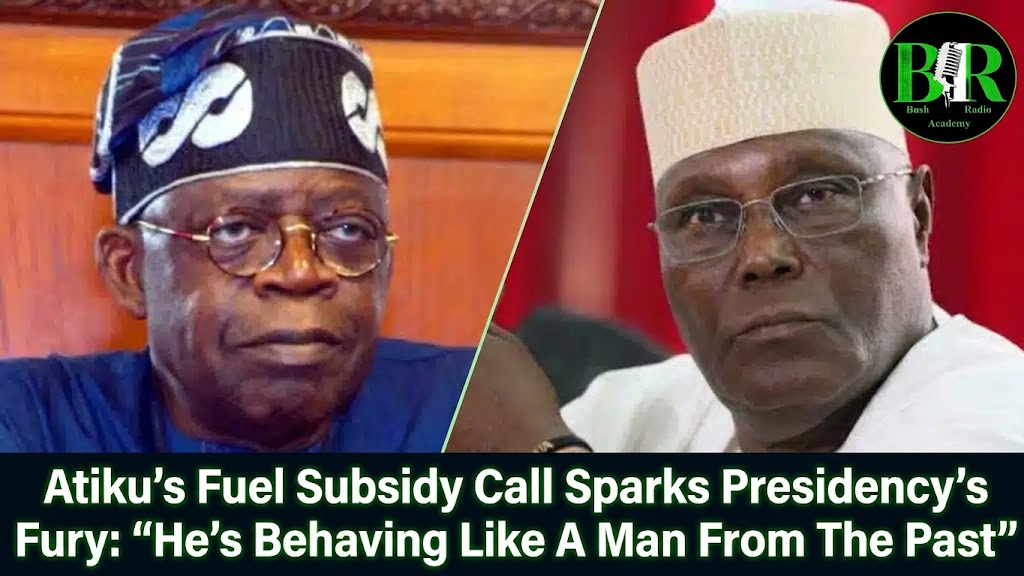
The Presidency has criticised African Democratic Congress (ADC) presidential candidate Atiku Abubakar over his promise to restore fuel subsidy if elected in 2027.
In a statement issued on Thursday, President Bola Tinubu’s Special Adviser on Information and Strategy, Bayo Onanuga, described Atiku’s proposal as retrogressive and argued that it does not reflect the realities of Nigeria’s current petroleum sector.
Onanuga also accused the former Vice President of abandoning his previous position on subsidy removal for political reasons.
He said the fuel subsidy regime, which he described as wasteful and corruption-prone, was effectively ended under the Petroleum Industry Act (PIA) in June 2023.
According to the presidential aide, Tinubu only accelerated the implementation of the policy by a few weeks after assuming office.
Onanuga said:
“Alhaji Atiku Abubakar, former Vice President and perennial candidate for the presidency of Nigeria, has finally revealed his economic plans to Nigerians, should he be elected as President by January next year.
“Against expectations that he would announce a more creative and ingenious alternative to the programme being executed by the Tinubu administration, Atiku Abubakar behaved like a man from an archaic past who least comprehends the present economic dynamics and suggested that he would restore the much-abused, wasteful, pillaged, corruption-ridden fuel subsidy regime.”
The Presidency also rejected Atiku’s claim about a ₦30 trillion subsidy windfall or savings, describing the figure as imaginary.
Onanuga explained that subsidy was not money sitting in government coffers waiting to be distributed to Nigerians. Rather, he said, it represented the difference between the actual cost of supplying petrol and the regulated pump price, which the government had previously absorbed.
He maintained that restoring the subsidy would require a new legal, fiscal and administrative framework, particularly because Nigeria’s petroleum industry has changed considerably since 2023.
The presidential aide pointed to the growth of domestic refining capacity, particularly the Dangote Refinery, arguing that the development would have been more difficult under the previous subsidy regime.
He also warned that bringing back the subsidy could hurt smaller local refineries, lead to job losses and increase pressure on Nigeria’s foreign exchange.
Onanuga said:
“Atiku’s proposal portends a reversal of current local production, and it will spell bankruptcy for smaller local refineries like Aradel’s, causing attendant job losses and a loss of foreign exchange.”
He further defended the Tinubu administration’s decision to remove the subsidy, arguing that the policy had increased revenue available to the three tiers of government.
According to him, funds that would previously have been used to subsidise petrol can now be deployed toward infrastructure and other government responsibilities.
Onanuga said the government cannot afford to return to a system in which the cost of subsidising petrol is eventually reflected in increased borrowing, higher public debt, reduced public spending or pressure on the naira.
He challenged Atiku to provide details of how he intends to finance the proposed subsidy if elected.
The presidential aide asked the ADC candidate to explain the projected annual cost, source of funding, proposed petrol pump price and whether legislative amendments to existing petroleum-sector laws would be required.
He also questioned what exactly a restored subsidy would cover given Nigeria’s growing domestic refining capacity.
Onanuga said:
“Political promises must be backed by fiscal arithmetic. Alhaji Atiku Abubakar is entitled to propose a different economic direction. Specific answers should accompany any promise to restore fuel subsidy.”
He added that Nigerians deserve a serious debate about the cost of living and economic policy but insisted that such discussions must reflect the country’s current petroleum market rather than the conditions of the past.
The Presidency maintained that sustainable relief for Nigerians should come through policies that reduce energy costs without returning the country to what it described as an opaque and financially burdensome subsidy regime.