
Behind Closed Doors: How Influential Buhari Aides Attempted To Hijack APC Presidential Ticket For Lawan
 Follow us on Google News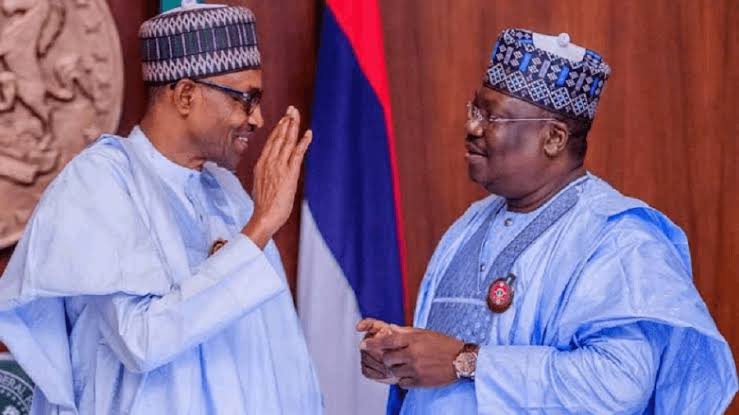
A newly released biography of the late former President Muhammadu Buhari has exposed the intense internal power struggles and alleged acts of betrayal that unfolded within the Presidential Villa, portraying a leader whose trust and proximity were exploited by powerful figures pursuing personal agendas.
The revelations are detailed in From Soldier to Statesman: The Legacy of Muhammadu Buhari, authored by Dr. Charles Omole and launched on Monday in Abuja in the presence of several dignitaries, including President Bola Ahmed Tinubu and Gambian President Adama Barrow.
Central to the book is a dramatic account of events on the eve of the 2022 All Progressives Congress (APC) presidential primaries. According to the author, influential figures close to Buhari approached the heads of Nigeria’s major security agencies—the Inspector-General of Police (IGP), the Director-General of the Department of State Services (DSS), and the Director-General of the National Intelligence Agency (NIA)—falsely claiming they were acting on the President’s directive to deploy security forces to ensure Senate President Ahmad Lawan emerged as the party’s “consensus” candidate.
Former IGP Usman Alkali Baba, quoted extensively in the book, immediately dismissed the purported instruction and convinced his colleagues that it lacked credibility.
“The trio agreed to seek an urgent meeting with the President,” the book recounts. “When they asked if there were any additional directives concerning the convention, the President replied that there were none.”
Upon being informed that celebrations were already underway in Lawan’s neighbourhood based on the alleged endorsement, Buhari reportedly laughed, making it clear that he had not anointed any candidate.
“He insisted that Nigerians should be allowed to choose freely and that security agencies must not interfere in the political process,” the account states, highlighting Buhari’s refusal to politicise state security institutions.
The biography also sheds fresh light on the controversial 2018 dismissal of former DSS Director-General Lawal Daura by then Acting President Yemi Osinbajo. While Buhari declined to reverse the decision—believing that doing so would undermine institutional authority—the book reveals that the move was strongly influenced by former First Lady Aisha Buhari, a detail that had not been widely documented at the time.
One of the most unsettling disclosures in the book is an incident involving gunshots within the Presidential Villa, reportedly stemming from a family dispute involving a police officer attached to the First Lady’s office.
Buhari’s Chief Security Officer, Idris Abubakar, swiftly arrested the officer. Subsequent investigations implicated members of the First Family, yet Buhari reportedly showed no leniency.
“A nephew was effectively told to pack his belongings and leave the house,” the book notes, emphasising that familial ties did not excuse misconduct.
Dr. Omole concludes that these episodes reveal a leader often mischaracterised as passive, arguing instead that Buhari’s restraint was grounded in principle and a deep respect for institutional order. The biography, he writes, seeks to separate “Buhari the man” from the myths and misconceptions that surrounded his presidency.