
Latest
Breaking Barriers, Building Systems: The First Female CMD’s Six-Month Scorecard At UBTH

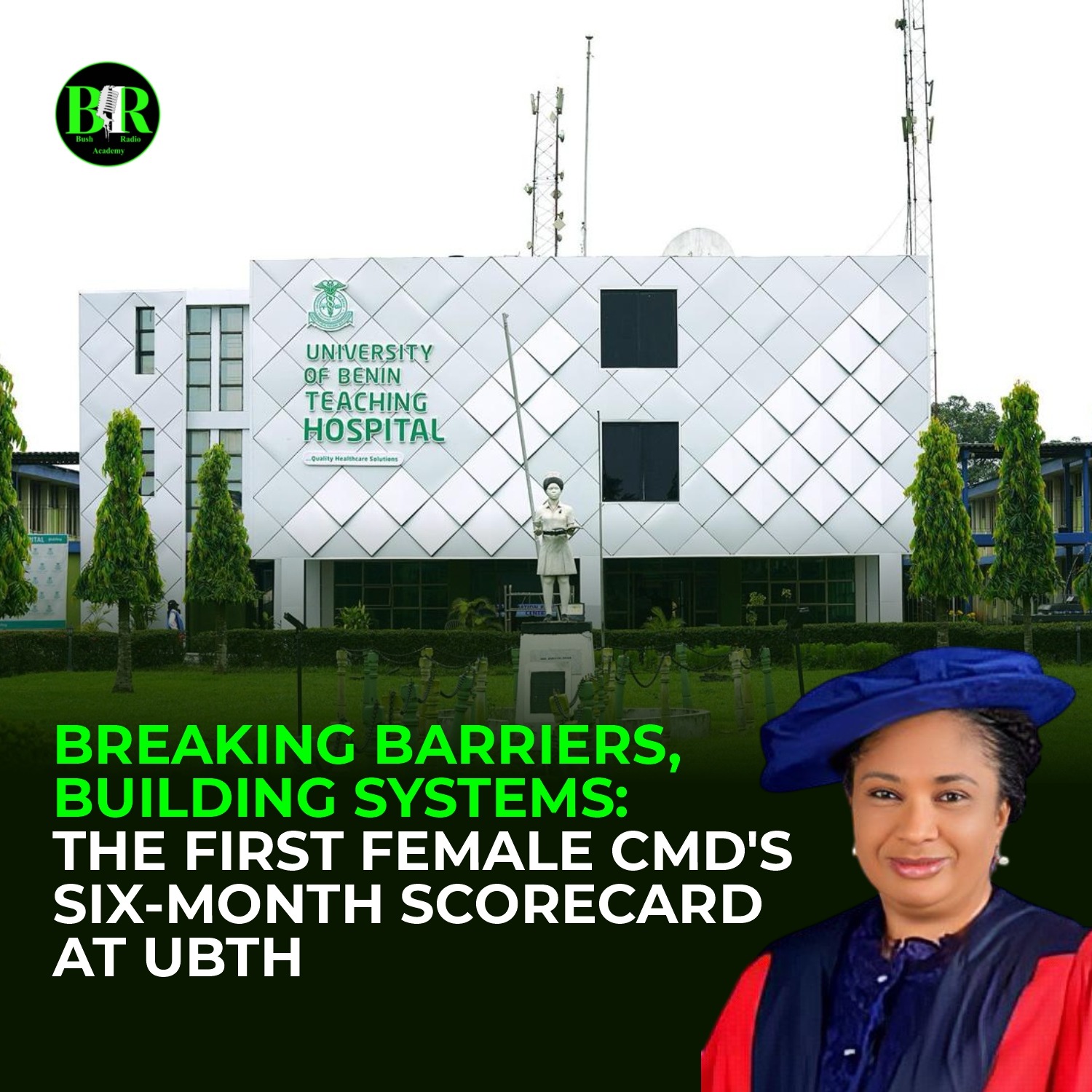
Bush Radio:
Six months into her tenure as Chief Medical Director of the University of Benin Teaching Hospital, Prof. (Mrs.) Idia Nibokun Ize-Iyamu has quietly turned heads, not with fanfare, but with steady, tangible progress that has begun to quiet early doubts.
UBTH is no ordinary institution. At 52 years old, it is steeped in history, layered with internal dynamics, and often shaped as much by politics as by policy.
Stepping into office on August 18, 2025, as the hospital’s first female Chief Medical Director and the first dentist to hold the position, Prof. Ize-Iyamu assumed leadership at a moment of heightened attention. Expectations were high. Scrutiny was inevitable. Public interest was pronounced.
Her marriage to a well-known pastor and political figure further amplified that visibility, placing her tenure under an even brighter spotlight. In such an environment, opinions often form quickly, and assumptions can precede performance.
As if the structural challenges were not enough, the early months of her administration coincided with periods of industrial action that disrupted full hospital operations. For any new leadership, strikes in the formative phase can stall momentum, complicate reforms, and delay implementation timelines.
Yet even within that constrained operating window, progress did not stall.
Leadership in complex institutions is rarely defined by speculation. It is ultimately shaped by delivery, direction, and measurable outcomes.
One of the most pressing issues she inherited was oxygen supply. The hospital had accumulated significant debts to vendors, straining relationships and raising genuine concerns about continuity of supply. Oxygen is not optional in a tertiary facility. It underpins emergency care, surgeries, intensive care units, and neonatal services.
Rather than deflect responsibility, the new administration focused on resolution. Outstanding obligations were addressed. Vendor confidence was rebuilt. Most importantly, the hospital’s 10-ton liquid oxygen plant was activated.
That single move shifted UBTH from vulnerable dependence on external suppliers to strengthened internal capacity, backed by a reliable reserve system. It was not cosmetic reform. It was structural stabilization.
Laboratory services were also strengthened with the acquisition of a cold centrifuge for the Blood Bank, improving the safety and integrity of blood processing. Key accreditations were secured or renewed in Ophthalmology, Emergency Medicine, Obstetrics & Gynaecology, and Family Medicine, reinforcing the hospital’s standing as a credible training institution.
Capacity-building initiatives followed. Heads of Department, management teams, and unit leaders underwent structured training, including external programs, signaling investment in institutional competence rather than surface-level change.
Infrastructure progress became visible.
The Golf Course House was commissioned to strengthen partnerships. A modern Police Post was opened to enhance security across the hospital environment. A Media & Public Health Communication Unit was constructed and commissioned to institutionalize transparent engagement. Work resumed on a previously abandoned NHIA building. The Staff Lounge is nearing completion, while the staff crèche is advancing steadily.
These are not decorative additions. They support morale, security, and workforce stability in a high-pressure teaching hospital.
Human capital expansion has been notable. Four hundred and one new staff members were employed within six months, widening service coverage and easing operational strain. For the first time in the hospital’s history, over 5,000 staff received yuletide support, a gesture modest in appearance but significant for morale in a legacy institution.
Community engagement has not been neglected. A four-day medical outreach during the Pre-Igue Festival at the Oba Palace reached more than 3,000 residents with free consultations, screenings, and medications. Ongoing support continues for cancer care, emergency caesarean services, and dialysis under the Renewed Hope health framework of Bola Ahmed Tinubu, coordinated through the Federal Ministry of Health led by Ali Pate. An Indigent Patients Fund was established to support vulnerable patients.
Strategically, engagements with alumni, legislators, development partners, and agencies are expanding revenue streams and public-private collaborations. Major projects are already in the pipeline, including a ₦2.5 billion ultra-modern Paediatric Complex pledged by Monday Okpebholo and a Federal Government-approved Surgical Simulation Centre.
Being the first woman to lead UBTH naturally invited heightened scrutiny. Leading during a period that included industrial disruptions only intensified that pressure. Yet when outcomes accumulate, oxygen stabilized, internal production activated, hundreds of staff recruited, accreditations secured, infrastructure advancing, and funding commitments lined up, narratives begin to recalibrate.
UBTH has not transformed overnight. Institutional reform rarely does. But it is no longer merely coping. It is stabilizing, modernizing, and positioning itself for sustained growth.
In just six months, even with early operational disruptions, the evidence suggests that this stewardship is not defined by speculation, but by structured progress.
Osigwe Omo-Ikirodah is the Principal and CEO of Bush Radio Academy.


I Made Over ₦10 Million Monthly Selling Akara And Bread — Governor Umo Eno Reveals

10 Years Later, Man Recalls Embarrassing Incident At GTBank

Falconets Ready For Tough Spain Clash, Coach Aduku Declares

Lagos Govt Issues Strong Warning To Husbands Over Forceful Sex With Wives

NDC Rejects INEC List, Says We Did Not Submit These Names

WHY OKPEBHOLO KNOWS WHAT HE IS SAYING ABOUT TINUBU’S 2.5 MILLION VOTES

Fake Agency Scandal: ICPC Recommends Punishment for 13 Officials — See Full List

Cement Hits ₦15,000: FCCPC Demands Answers From Dangote, BUA, Other Producers

Was The Sacrifice Worth It?” – El-Rufai’s Son Reveals What Father Told Him In Detention
