Mrs. Akpelu Celin began the planting season with hopes of a rewarding harvest after investing her savings in land preparation, labour and cassava stems. However, her expectations were shattered when torrential rainfall flooded her farmland in Umuagwo, Imo State, submerging and destroying a large portion of the newly planted cassava.
Celin, who is among farmers in communities hosting the University of Agriculture and Environmental Sciences (UAES), Umuagwo, said the devastating experience wiped out much of her investment and left her uncertain about the future of her farm.
She explained that the heavy rainfall came shortly after planting, leaving several cassava stems submerged and damaged. The loss, she said, affected her plans to use the expected proceeds from the harvest to support her family.
According to her, changing weather patterns have made farming increasingly unpredictable, with farmers struggling to determine when conditions are suitable for planting and harvesting.
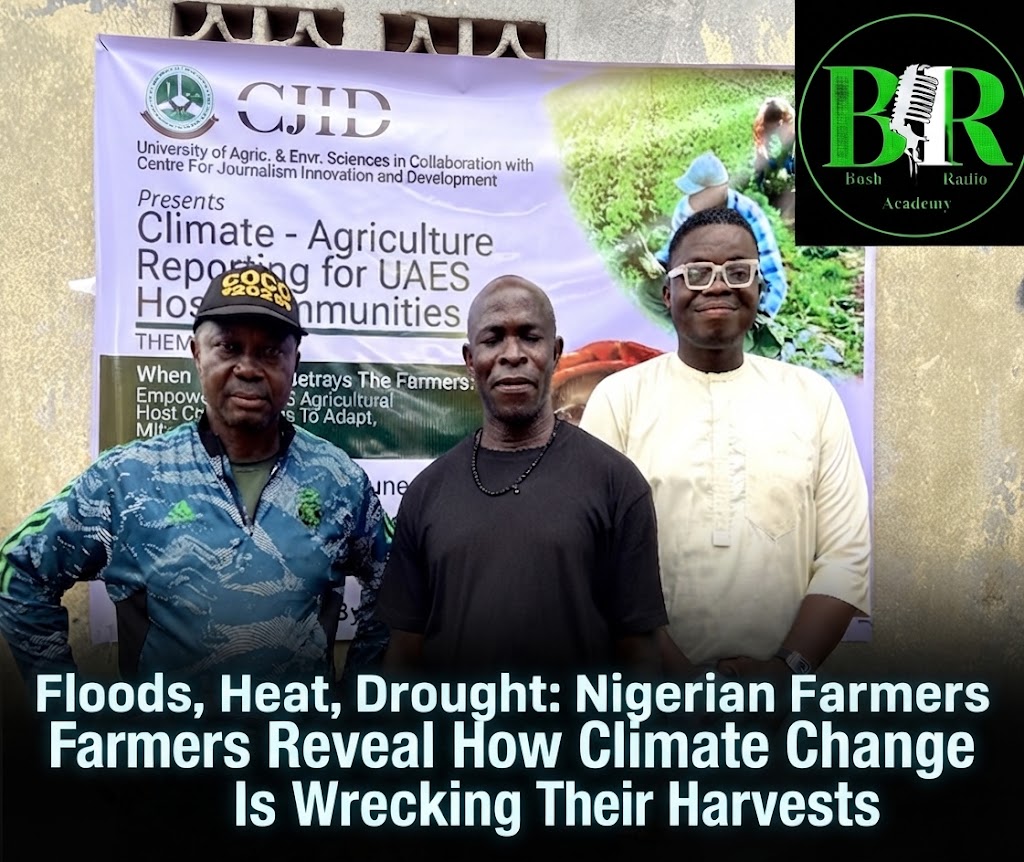
Celin’s experience formed part of several testimonies presented by farmers during a climate-agriculture reporting engagement organised with the support of the Centre for Journalism Innovation and Development (CJID), Abuja, in collaboration with UAES.
The engagement, which brought together farmers from Umuagwo, Umuapu and Mgbirichi communities, provided a platform for participants to discuss how changing climatic conditions are affecting agricultural production and household incomes.
Farmers reported a range of challenges, including flooding, prolonged dry spells, extreme heat, pest attacks, crop diseases and declining yields.
For many of the participants, climate change has moved beyond being an environmental concern to becoming a direct threat to their livelihoods, as unpredictable weather conditions continue to result in crop failures, increased production costs and reduced income.
A cucumber farmer, Mrs. Agugwo Chioma, also recounted how excessive rainfall and flooding severely affected her farm. She said water remained on the farmland for several days, damaging several plants and creating conditions that encouraged diseases.
Chioma said the poor harvest significantly reduced her expected income, stressing that farmers and their families bear the consequences whenever extreme weather destroys their crops.
While some farmers complained about excessive rainfall, others described the opposite problem.
Mr. Calistus Paul, a banana and plantain farmer, said a prolonged dry spell during the dry season deprived his crops of the moisture they needed, resulting in poor growth and significantly lower yields.
He said the reduced harvest affected his income and made it difficult to meet both business obligations and family responsibilities.
As farmers shared their experiences, a recurring concern emerged over the increasing unreliability of weather patterns that traditionally helped them determine when to plant and harvest.
However, the engagement also focused on possible solutions, with farmers, researchers and development practitioners discussing climate-smart agricultural practices, improved weather information, better drainage systems, crop diversification, improved crop varieties and stronger extension services.
A cassava and yam farmer, Mr. Osundu Anudokum, said the programme had provided him with practical knowledge that could help him better manage the effects of irregular rainfall.
He expressed optimism that adopting the recommended climate adaptation techniques would improve productivity, increase farm income and contribute to a better standard of living for his family.
Similarly, Mrs. Ihenatu Priscly described the initiative as timely, saying the training had strengthened her confidence ahead of the next planting season.
She commended CJID and the Vice-Chancellor of UAES, Prof. Chiedozie Christopher Eze, for taking the programme directly to farmers in the host communities, particularly at a time when they needed practical knowledge and support to cope with changing weather conditions.
Providing an expert perspective, the Acting Dean of the Faculty of Agriculture, UAES, Dr. Chizoma Osuagwu, said building farmers’ resilience would require continuous access to knowledge, innovation and agricultural extension services.
She noted that climate change was reshaping agricultural production across Nigeria and urged farmers to adopt climate-smart practices, improved crop management techniques and timely weather information to minimise production risks.
Osuagwu also stressed the importance of partnerships among universities, government agencies, development organisations and local communities in converting research findings into practical solutions capable of improving the livelihoods of smallholder farmers.
An agricultural extension agent, Mrs. Nneka Stella, similarly urged farmers to reconsider traditional farming methods and embrace innovations designed to strengthen resilience against extreme weather.
She identified limited access to timely agricultural information and extension services as factors worsening farmers’ vulnerability, adding that regular training, reliable weather forecasts and climate-smart practices could help reduce losses.
Stella encouraged farmers to adopt improved planting techniques, diversify their crops, conserve soil moisture during dry periods and respond promptly to weather advisories.
She said the success of programmes of this nature would ultimately depend on farmers applying the knowledge gained to their farms, which could help stabilise yields, improve household incomes and strengthen food security.
The Vice-Chancellor, Prof. Chiedozie Christopher Eze, welcomed the collaboration between UAES and CJID, describing it as a demonstration of the university’s commitment to community engagement and sustainable development.
Eze reaffirmed the institution’s commitment to improving agricultural and environmental outcomes in its host communities, Imo State and Nigeria through research, innovation, training and the dissemination of modern agricultural technologies.
He maintained that equipping farmers with practical knowledge and evidence-based innovations remained crucial to increasing productivity, strengthening rural livelihoods and developing farming communities capable of withstanding climate-related challenges.
The Head of the Council of Chiefs, Chief Eze Charles Ezeokwubudu, also expressed appreciation to the university management and CJID for bringing the initiative directly to the communities.
He said the engagement had provided farmers with an opportunity to voice their concerns about the impact of climate change while giving them renewed hope that their challenges were receiving attention.