
Latest
“THE RULE MAY ALSO CATCH AKPABIO” Oshiomhole Warns Against Turning Senate Laws Into Political Weapons

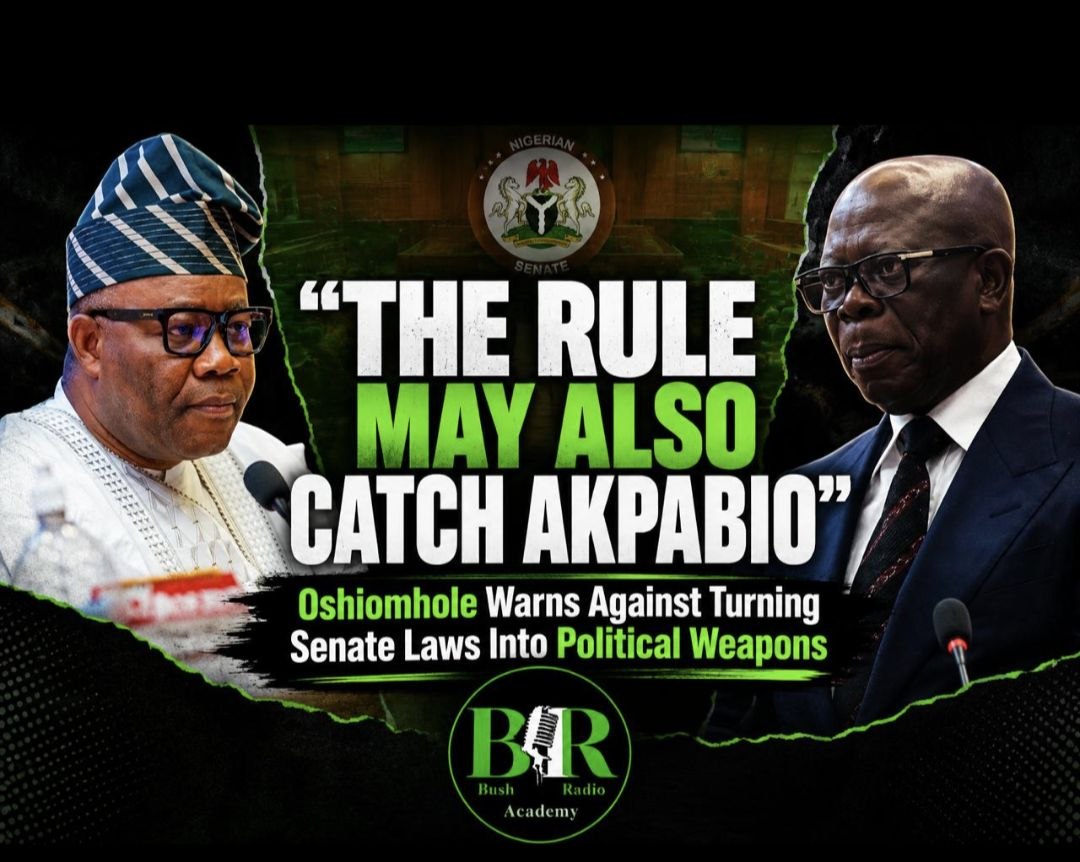
“THE RULE MAY ALSO CATCH AKPABIO” Oshiomhole Warns Against Turning Senate Laws Into Political Weapons
When many politicians speak, they defend personalities.
When Adams Oshiomhole speaks in moments like this, he often tries to defend the institution itself. And that is why whether people love him or hate him, they rarely ignore him.
His interview on Arise News was not just about Senate ranking rules.
It was a deeper warning about something dangerous in African politics:
The temptation to bend institutions around individuals.
At the center of the conversation was the debate around Senate leadership qualification, tenure interpretation, and the controversial use of the word “consecutively” in determining ranking and eligibility.
But beneath the grammar of Senate rules, Oshiomhole was really discussing power.
And this is where the interview became explosive.
THE CORE OF OSHAIMHOLE’S ARGUMENT
Oshiomhole essentially raised three major points:
1. Laws Must Never Be Written Around Individuals
This was his loudest message.
He argued that once lawmakers begin adjusting rules because of a particular political figure, democracy starts sliding into selective governance.
According to him, rules should be permanent principles, not temporary political tools.
That was why he referenced Senate President Godswill Akpabio.
Not necessarily to attack him personally, but to expose what he sees as inconsistencies in interpretation.
Oshiomhole pointed out that if total years of service matter, then Akpabio himself may not fully satisfy the proposed interpretation, considering his interrupted Senate journey before returning as Senate President.
Practically, Oshiomhole’s point was that if the proposed rule insists on an eight-year threshold, then Akpabio himself may not yet have fully accumulated those years continuously within the Senate framework.
And if the argument shifts to “consecutive years,” it still creates another contradiction because interrupted tenures and exits from the Senate may no longer fully count under that interpretation.
In essence, Oshiomhole was arguing that if a rule is interpreted strictly enough to potentially disqualify others, then fairness demands that the same interpretation must also apply to everyone equally, including current beneficiaries of the system.
And according to the logic of the rule itself, if an error was made in electing a Senate President who does not fully meet the interpretation being promoted, then such an error should logically be corrected.
That contradiction, according to him, exposes the danger of tailoring rules around immediate political calculations.
In simple terms:
Today’s beneficiary can become tomorrow’s victim.
That was the philosophical heart of his argument.
2. POWER MUST COME FROM TRUST, NOT RULE MANIPULATION
This was where Oshiomhole invoked David Mark.
And this part carried heavy institutional symbolism.
David Mark spent eight years as Senate President not because the rules were bent for him, but because senators repeatedly trusted him.
Oshiomhole’s point was sharp:
If your colleagues want you, they will elect you.
If your people re-elect you, and senators trust your leadership, you do not need artificial barriers protecting your seat.
That statement was bigger than the Senate.
It applies to governors.
Presidents.
Party chairmen.
Even political godfathers.
Democracy survives when leadership is renewed through confidence.
It begins to decay when leadership survives through engineered restrictions.
3. AFRICA’S BIGGEST PROBLEM STARTS SMALL
This was arguably the deepest line in the entire interview.
Oshiomhole warned that dictatorship does not usually arrive wearing military camouflage anymore.
It often begins quietly through procedural manipulation.
A word added here.
A clause adjusted there.
An interpretation twisted for convenience.
Then suddenly institutions stop serving the people and start protecting power itself.
That was why he referenced Cameroon and long-term African strongmen.
His message was clear:
The road to democratic decline often starts with “small political adjustments.”
Tiny legal edits can eventually produce untouchable political structures.
And this is why he sounded alarmed.
WHY OSHAIMHOLE OFTEN APPEARS “A STEP AHEAD”
One thing about Oshiomhole is this:
He understands both street politics and institutional politics.
That combination is rare.
Many politicians understand elite negotiations but cannot interpret public anger.
Others understand populism but lack institutional depth.
Oshiomhole operates in both worlds simultaneously.
Remember:
- He emerged from labor activism.
- He fought military-era establishment structures.
- He governed a strategic state.
- He chaired the ruling party nationally.
- He has survived internal political wars multiple times.
So when he hears certain political conversations, he often interprets not just the immediate effect, but the long-term institutional danger behind them.
That is why many Nigerians see him as someone who sometimes speaks before others fully grasp the implications.
He studies the pattern behind the moment.
THE BIGGER IMPLICATION FOR NIGERIA
This interview was never really about one Senate rule.
It was about whether Nigerian democracy will remain competitive or gradually become administratively protected.
Because once rules start looking customized, public trust begins collapsing.
And once citizens stop trusting institutions, politics becomes dangerous.
That is the deeper warning hidden inside Oshiomhole’s words.
He was not merely defending senators.
He was defending the principle that no office should become permanently protected by manipulated procedures.
In his view, leadership must remain contestable.
Because the day democracy stops allowing fair competition…that is the day institutions quietly begin transforming into political fortresses. 🔥
Osigwe Omo-Ikirodah is the Principal and CEO of Bush Radio Academy


I Made Over ₦10 Million Monthly Selling Akara And Bread — Governor Umo Eno Reveals

10 Years Later, Man Recalls Embarrassing Incident At GTBank

Falconets Ready For Tough Spain Clash, Coach Aduku Declares

Lagos Govt Issues Strong Warning To Husbands Over Forceful Sex With Wives

NDC Rejects INEC List, Says We Did Not Submit These Names

WHY OKPEBHOLO KNOWS WHAT HE IS SAYING ABOUT TINUBU’S 2.5 MILLION VOTES

Fake Agency Scandal: ICPC Recommends Punishment for 13 Officials — See Full List

Cement Hits ₦15,000: FCCPC Demands Answers From Dangote, BUA, Other Producers

Was The Sacrifice Worth It?” – El-Rufai’s Son Reveals What Father Told Him In Detention
