
Latest
Full List: Ex-Governors, Former Minister Sentenced To Jail Over Fraud, Corruption

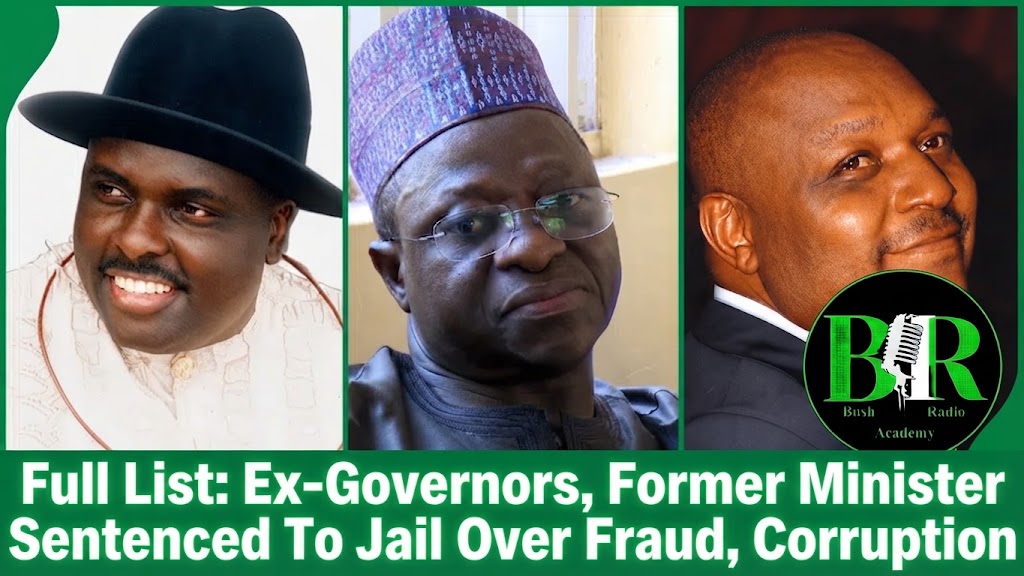
Nigeria’s long-running fight against corruption has seen several prominent politicians and former public office holders prosecuted and, in some cases, convicted and sentenced for offences ranging from diversion of public funds and money laundering to fraud and abuse of office.
According to Bush Radio Academy, although many corruption cases involving politicians have remained in court for years without final convictions, a number of high-profile figures have received prison sentences either in Nigeria or abroad. Some convictions were later overturned on appeal, while others were upheld before the affected individuals subsequently benefited from presidential pardons.
Former Delta State Governor James Ibori remains one of the most notable Nigerian politicians to have served a prison sentence for financial crimes. Ibori, who governed Delta State from 1999 to 2007, pleaded guilty at Southwark Crown Court in London in 2012 to fraud and money laundering-related offences and was sentenced to 13 years in prison.
His conviction in the United Kingdom came after an earlier prosecution in Nigeria failed to secure a conviction. Ibori was released in December 2016 after serving part of his sentence, with time already spent in custody taken into account. His case subsequently remained connected to asset-recovery proceedings in the UK.
Former Plateau State Governor Joshua Dariye was convicted in 2018 following a lengthy prosecution over the diversion of the state’s ecological funds. Dariye, who served as governor between 1999 and 2007 before becoming a senator, was initially sentenced to 14 years for criminal breach of trust and two years for misappropriation of public funds, with the terms running concurrently.
The Court of Appeal later reduced his principal sentence to 10 years, a punishment that was subsequently upheld by the Supreme Court in March 2021. Dariye, however, did not complete the sentence after receiving a presidential pardon from the administration of former President Muhammadu Buhari in 2022. He was released from Kuje Custodial Centre in August of that year.
Former Taraba State Governor Jolly Nyame also served time following his conviction for corruption involving public funds. Nyame, who governed Taraba from 1999 to 2007, was convicted by an FCT High Court in May 2018 after a trial that lasted about 11 years.
The court found him guilty on multiple counts relating to the diversion of approximately ₦1.64 billion belonging to the state and initially sentenced him to 14 years in prison. The Court of Appeal later reduced the sentence to 12 years, while the Supreme Court affirmed the 12-year term in February 2020. Nyame subsequently benefited from the presidential pardon granted by the Buhari administration in 2022.
Former Edo State Governor Lucky Igbinedion was also convicted following an EFCC prosecution concerning the handling of state funds. Igbinedion, who served as governor between 1999 and 2007, entered into a plea bargain in 2008 and was convicted by the Federal High Court in Enugu after pleading guilty to a charge.
He was sentenced to six months in prison with an option of a ₦3.5 million fine, which he paid. The outcome generated public debate at the time, particularly over the relatively light punishment compared with the financial allegations involved.
The late former Bayelsa State Governor Diepreye Alamieyeseigha was convicted in 2007 on corruption and money laundering-related charges. Alamieyeseigha governed the state from 1999 to 2005 before his impeachment.
Following prosecution by the EFCC, he pleaded guilty to corruption-related offences and was sentenced to two years in prison. He was released after the period he had already spent in custody was taken into consideration. In 2013, he received a presidential pardon from then-President Goodluck Jonathan, a decision that attracted significant public controversy.
Former Adamawa State Governor James Bala Ngilari was sentenced to five years in prison in 2017 after a trial court convicted him of procurement-related offences involving approximately ₦167 million. The case concerned the procurement of vehicles during his administration, and the sentence was imposed without an option of a fine.
However, the conviction did not stand on appeal. The Court of Appeal subsequently overturned the judgment and discharged Ngilari, meaning he is distinct from those whose convictions remained legally valid after the appellate process.
Former Abia State Governor and senator Orji Uzor Kalu was convicted by the Federal High Court in Lagos in December 2019 over the alleged diversion of billions of naira belonging to Abia State. He was sentenced to 12 years in prison after being found guilty of fraud and money laundering charges and began serving the sentence.
However, the Supreme Court in May 2020 nullified the trial and conviction on procedural grounds and ordered a retrial. Consequently, the 2019 conviction ceased to have legal effect.
Former Minister of Power Saleh Mamman became one of the latest former senior government officials to receive a lengthy sentence in a financial-crime case. In May 2026, a Federal High Court in Abuja convicted Mamman on 12 counts involving the laundering of approximately ₦33.8 billion allegedly linked to government-funded power projects.
Justice James Omotosho imposed cumulative sentences amounting to 75 years, although some of the terms were to run concurrently. The judgment was delivered in Mamman’s absence, and the court directed Nigerian and international law enforcement agencies to apprehend him so that he could serve the sentence.
The cases involving the former public officials reflect the lengthy and sometimes complicated nature of corruption prosecutions in Nigeria, with outcomes ranging from convictions and prison sentences to successful appeals, retrials and presidential pardons.


Erigga Fires Back At Davido With Blunt Message Over Poor Men Comment

Anthony Joshua Yet To Sign Tyson Fury Contract As Mega Fight Hangs In Balance

Dangote Backs Tinubu’s Reforms, Declares Nigeria Is Finally On The Right Path

Full List: Nollywood Stars Who Have D!ed In 2026 As Industry Mourns

Disney Star Carla Jeffery D!es, Fans Mourn Sudden Loss

WHY OKPEBHOLO KNOWS WHAT HE IS SAYING ABOUT TINUBU’S 2.5 MILLION VOTES

Fake Agency Scandal: ICPC Recommends Punishment for 13 Officials — See Full List

Cement Hits ₦15,000: FCCPC Demands Answers From Dangote, BUA, Other Producers

Was The Sacrifice Worth It?” – El-Rufai’s Son Reveals What Father Told Him In Detention
