
No Court Reinstatement For Natasha Akpoti-Uduaghan – Fadugba Breaks Silence
 Follow us on Google News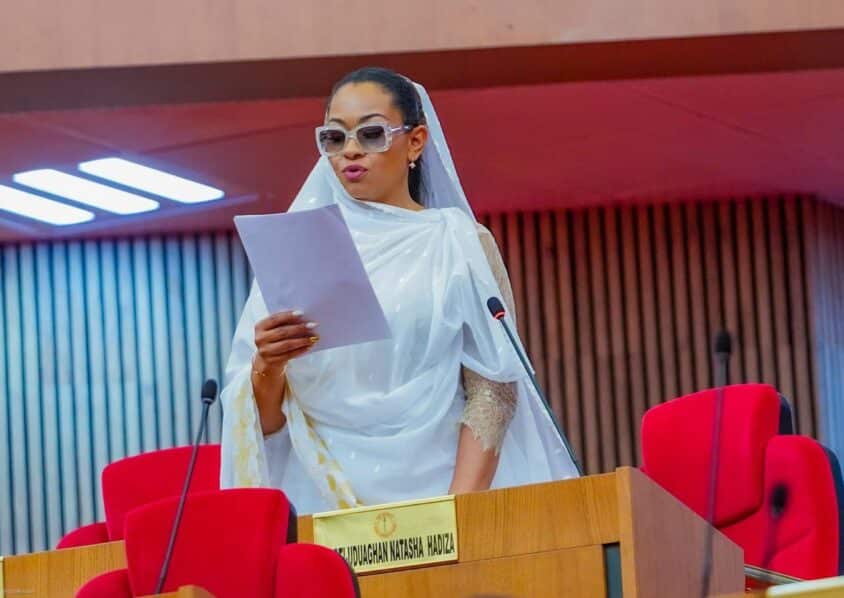
Contrary to widely circulated reports and legal assumptions, the Federal High Court in Abuja did not issue any ruling directing the Senate to reinstate Senator Natasha Akpoti-Uduaghan after her suspension.
This clarification came on Sunday following the public release of the certified true copy of the judgment delivered by Justice Binta Nyako on July 4, 2025.
The case, filed by Akpoti-Uduaghan against the Clerk of the National Assembly and three others, generated intense media attention. Some outlets had claimed that the court nullified her suspension and ordered her immediate return to the Senate. However, a close analysis of the court’s decision reveals that no such ruling was made.
According to Vanguard, legal expert Dayo Fadugba, who reviewed the full judgment, stated that Justice Nyako did not issue any binding order to overturn the suspension or compel the Senate to reinstate the Kogi senator before her six-month term elapsed.
Fadugba explained that the court only offered an obiter dictum—a non-binding observation—on the length of the suspension. Justice Nyako noted that if the National Assembly sits for around 181 days per year, a 180-day suspension might be excessive. However, this was not translated into any legal directive.
The central ruling (ratio decidendi), reaffirmed the Senate’s constitutional power—under Section 60 of the 1999 Constitution—to govern its internal affairs, including disciplinary action against members.
Justice Nyako ruled that Akpoti-Uduaghan was properly referred to the Senate Committee on Ethics, Privileges, and Public Petitions over alleged misconduct during the February 20, 2025 plenary. While the senator sought judicial intervention, the court found that the Senate followed due process and acted within its constitutional mandate.
The judgment emphasized the principle of separation of powers, warning against judicial interference in legislative operations unless there’s clear proof of a constitutional breach or human rights violation.
Referencing cases such as AG Bendel v. AG Federation, Unongo v. Aku, and Senator Ndume v. President of the Senate, Justice Nyako highlighted that courts should refrain from meddling in legislative deliberations or disciplinary matters, provided fair procedures are followed.
“There is no allegation or evidence that the defendants violated any statutory or constitutional provision,” the court stated. It concluded that Akpoti-Uduaghan’s legal suit appeared to be an attempt to bypass the Senate’s disciplinary framework—not a genuine constitutional grievance.
Fadugba described the judgment as a “strong affirmation of constitutional boundaries”, warning that portrayals of the ruling as a legal victory over the Senate are misleading.
“There was no recall order, no finding of wrongdoing by the Senate, and no judicial intrusion into parliamentary affairs,” he said.
Ultimately, the ruling underscores the autonomy of the legislature and the limited role of the judiciary in its internal processes.







Comments
0 comments