


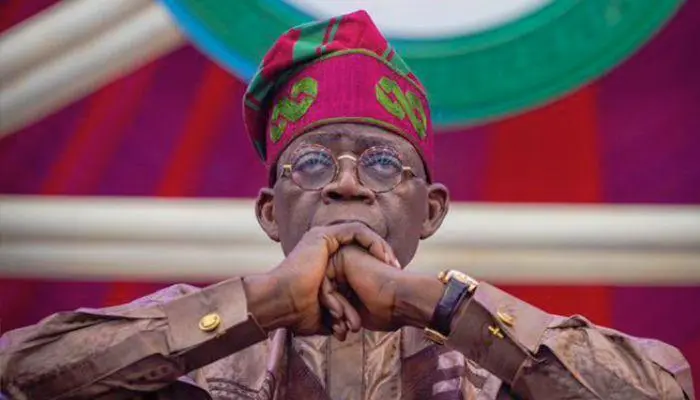
Rephrased statement: “People don’t seek superficial solutions to complex questions, nor do they desire recycled, uninspired, or unfulfilled pledges,” stated Bola Tinubu, the former presidential aspirant, in his book “Renewed Hope,” page 2.....KINDLY READ THE FULL STORY HERE▶
Typically, I’ve avoided engaging in the frenzy of evaluating Presidents and Governors’ performances after their first 100 days in office, particularly those newly elected.
Broken promises from politicians are as common as saltwater in the ocean. However, my Saturday Editor requested an evaluation….CONTINUE READING
He’s the boss, so I retrieved my copy of “Renewed Hope,” which contains Tinubu’s list of promises, intending to keep it in my archives for a future reference. One thing was clear even before my third reading: many of these promises may never be fulfilled.
The reasons are straightforward. Tinubu has never held a high-ranking position in the Federal Government, which means he has limited knowledge of how the complex system operates. Moreover, President Buhari kept him largely uninformed about their activities, leaving him ignorant of what he would inherit.
Nigeria isn’t the same as Lagos State, and Tinubu should have learned from the failures of his former subordinates in Lagos State—Osinbajo, Fashola, Lai Mohammed, and Fowler—all of whom served under Buhari and saw their reputations suffer. He took on a task for which he was poorly prepared, as indicated by the “Renewed Hope” document.
“Our party, the All Progressives Congress (APC), was established on the principle that the people of our beloved nation deserve the benefits that only progressive governance can provide,” reads the front cover of “Renewed Hope.”
One of the promises outlined in the manifesto, under the sub-heading “Ensure Stability of Petroleum Product Supply,” included the following commitments on page 37:
- Achieve stability in the supply of petroleum products by fully deregulating the downstream sector and ensuring that local refinery capacity meets domestic consumption needs.
- Gradually phase out fuel subsidies while maintaining the underlying social contract between the government and the people.
- Our planned approach not only mitigates the price impact of deregulation but also leads to significant expansion of public infrastructure and improvements in public well-being.


